


The O Level vs A Level Program comparison highlights key differences in curriculum, assessment, and academic goals. O Levels build a broad foundation, while A Levels focus on specialization and university preparation. Understanding these differences helps students choose the right academic path aligned with career goals and higher education opportunities.
Choosing between secondary and pre-university qualifications can be challenging, especially when students and parents are unsure about the academic structure and future impact of each program. Understanding the O Level vs A Level Program is essential for making informed academic decisions that align with long-term career and university goals.
The O level vs A level comparison highlights key distinctions in syllabus depth, assessment methods, subject flexibility, and the academic skills each program develops. While the O Level program provides a strong foundation in core subjects, the A Level program focuses on specialization and prepares students for university-level studies.
At Knowledge Kastle, students receive guidance to navigate these differences effectively. From selecting the right subjects to understanding how each program aligns with academic and career objectives, Knowledge Kastle helps learners make strategic decisions that set them up for success.
This article explores the fundamental differences between O Level and A Level programs, providing clarity for students and parents seeking the most suitable educational pathway.
What are the key differences between O Level and A Level programs?
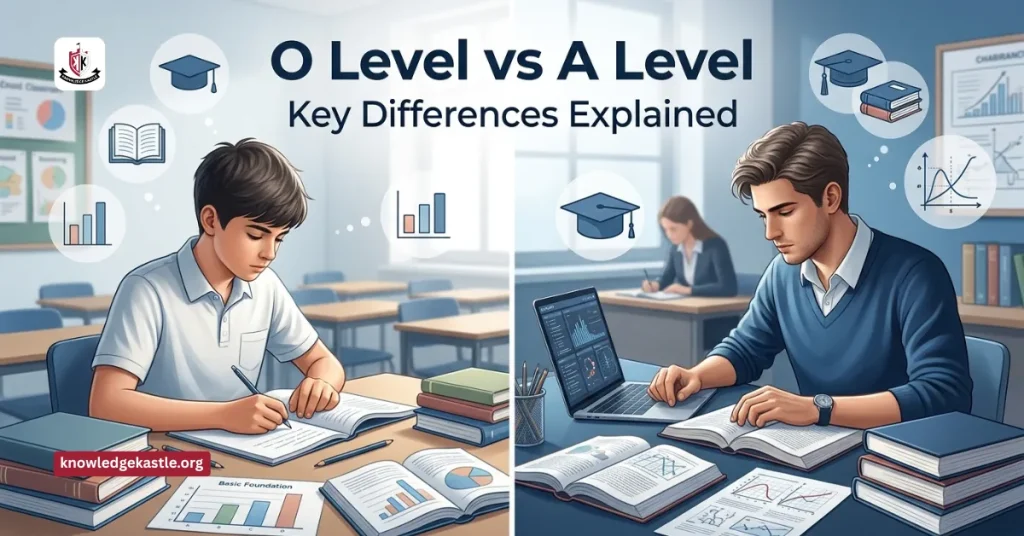
O Levels provide a broad foundation across core subjects, focusing on basic knowledge, problem-solving, and study skills, preparing students for advanced education. A Levels are specialized, pre-university programs emphasizing in-depth subject mastery, critical thinking, independent learning, and research skills. They align with UK and international university requirements, giving students a competitive edge for higher education and global career opportunities.
1. Purpose and Academic Stage
When students ask, “O Level vs A Level, which is better?”, the answer largely depends on understanding the purpose and academic stage of each program. One of the primary distinctions between O Level and A Level lies in the role they play within a student’s educational journey.
O Level: Building a Foundation
The O Level program is typically completed during secondary education (usually ages 14–16) and serves as a foundational qualification. Its purpose is to:
- Introduce students to a broad range of subjects, including English, Mathematics, Sciences, and Humanities
- Develop basic analytical, problem-solving, and study skills
- Prepare students for advanced studies, such as the A Level program or other pre-university pathways
Knowledge Kastle supports students at both stages by offering guidance, resources, and structured learning pathways tailored to their level of study.
A Level: Specialized Advanced Study
The A Level program is an advanced qualification taken after O Levels or equivalent (usually ages 16–19). Its purpose is to:
- Allow students to specialize in a select number of subjects relevant to their intended university degree or career path
- Develop in-depth knowledge, critical thinking, and independent learning skills
- Meet specific A-level university requirements for admission to competitive universities in the UK and internationally
While O Levels provide a broad academic foundation, A Levels focus on specialization and advanced study. Recognizing this distinction helps students plan their academic journey strategically, ensuring a smooth transition from secondary education to higher education.
2. Curriculum Structure and Subjects
Another key aspect in the O level vs A level comparison is the difference in curriculum structure and the range of subjects offered. Understanding how each program organizes its syllabus helps students plan their studies effectively and make informed choices.
O Level: Broad and Foundational
The O Level program covers a wide range of subjects, providing students with a strong academic foundation. Typical features include:
- Core Subjects: English Language, Mathematics, and Science (Physics, Chemistry, Biology)
- Elective Subjects: Humanities, Arts, Computer Science, and Foreign Languages
- Balanced Exposure: Students gain knowledge across multiple disciplines, developing essential study skills and general academic competence
A Level: Specialized and In-Depth
The A Level program allows students to focus on a smaller number of subjects with greater depth, usually three to four:
- Students choose A-level subject combinations based on their career goals and university requirements
- Emphasis is on critical thinking, problem-solving, and application of knowledge rather than breadth
- Assessment includes extensive written exams, research projects, and sometimes practical work
By comparing curriculum structure and subject focus, students can clearly see the progression from a broad foundation at O Level to specialized preparation at A Level.
Strategic Subject Selection
While O Levels encourage exploration across disciplines, A Levels require strategic planning to align subjects with future academic or professional goals. For example:
- Science-focused students may choose Biology, Chemistry, and Mathematics
- Humanities-focused students may select History, Sociology, and English
Knowledge Kastle Support
Knowledge Kastle helps students understand the curriculum structure of both O Levels and A Levels, provides guidance in selecting the right subjects, and offers resources to master each subject effectively.
3. Assessment and Grading
A major difference between the O-level and A-level is how students are assessed and graded. Understanding the assessment methods of each program helps learners prepare more effectively and adopt the right study strategies.
O Level: Broad-Based Assessment
Another key difference between O Level and A Level lies in the assessment style:
- Examination Focused: Most O Level subjects are assessed through written exams at the end of the course.
- Grading Scale: Typically uses grades A* to E, with A* representing the highest level of achievement.
- Emphasis on Knowledge Recall: Questions test understanding of core concepts, factual knowledge, and basic problem-solving skills.
- Practical Work: In science subjects, practical assessments may be included or replaced with Alternative to Practical (ATP) assessments.
By understanding the differences in assessment and grading, students can tailor their study approaches to succeed in both programs and transition smoothly from O Level to A Level studies.
A Level: In-Depth Evaluation
- Advanced Assessment: A Levels use a combination of written exams, coursework, practical assessments, and research-based tasks depending on the subject.
- Grading Scale: Uses A* to E, but assessments demand higher-order thinking, analytical skills, and application of knowledge.
- Critical Thinking Focus: Questions are designed to test reasoning, evaluation, and problem-solving abilities rather than simple memorization.
- Preparation for University: The assessment style mirrors university-level expectations, encouraging independent learning and intellectual rigor.
Knowledge Kastle provides students with practice papers, past exam solutions, and guided tutorials to understand assessment patterns for both O Levels and A Levels. This helps students develop the skills required to excel under each grading system.
4. Study Approach and Workload
One of the most noticeable differences between O Level and A Levelis the study approach and the workload students experience. Understanding this can help learners adjust their strategies for success.
- O Level Study Approach:
O Levels focus on building a strong foundation across multiple subjects. Students are expected to understand key concepts, memorize essential facts, and develop basic problem-solving skills. The workload spans a broad range of subjects, requiring students to manage their time effectively to cover all topics. The emphasis is on consistent study habits and regular revision.
- A Level Study Approach:
In contrast, A Levels demand a deeper, more analytical approach. Students usually specialize in 3–4 subjects and explore them in greater depth. Learning at this stage is more independent, often requiring critical thinking, research, and application of knowledge to solve complex problems. The workload may be intense due to the specialized nature of the subjects and the higher expectations from assessments.
Key Takeaway: While O Levels develop broad knowledge and disciplined study habits, A Levels train students to handle complex topics and develop analytical skills crucial for university studies. Understanding this difference helps students prepare successfully for the transition from O Level to A Level.
5. University and Career Implications
One of the most significant distinctions in the O level vs A level comparison is how each program influences future university admissions and career opportunities. Understanding these implications helps students make strategic academic choices aligned with their long-term goals.
O Level: Foundation for Higher Studies
O Levels lay the groundwork for higher education by providing a broad understanding of core subjects.
- Preparation Stage: O Levels provide a broad academic foundation, equipping students with essential knowledge and study skills.
- Next Steps: Successful completion is generally required before progressing to advanced qualifications such as A Levels, International Baccalaureate (IB), or other pre-university programs.
- Career Exploration: Exposure to multiple subjects helps students identify strengths and interests, guiding future subject selections and career paths.
They are not typically used directly for university admissions but are essential for progressing to A Levels, IGCSE, or equivalent programs. Performing well in O Levels can open doors to advanced programs and build a strong academic record that universities and colleges recognize.
A Level: University Readiness and Specialization
A-levels are critical for university admissions worldwide. High grades in specialized subjects can determine eligibility for competitive programs, scholarships, and professional pathways.
- Meeting University Requirements: A Levels are directly aligned with A-level university requirements, making students eligible for undergraduate programs in the UK and internationally.
- Subject Specialization: Strategic A-level subject combinations allow students to tailor their studies to their intended degree, whether in medicine, engineering, business, or humanities.
- Competitive Edge: Universities value the depth and rigor of A Levels, often considering them as proof of academic ability and readiness for university-level study.
- Global Opportunities: High-performing A Level students can access scholarships, international programs, and prestigious institutions worldwide.
A-level results in Mathematics and Physics can pave the way for engineering programs, while excellent grades in Biology and Chemistry support medical school applications.
Knowledge Kastle Guidance
Knowledge Kastle helps students understand the long-term implications of both O Levels and A Levels. By offering personalized guidance on subject selection, exam preparation, and university requirements, Knowledge Kastle ensures students are strategically positioned for higher education and career success.
Conclusion
Understanding the difference between O-level and A-level programs is essential for students planning their academic journey and future career paths. While the O Level program provides a broad foundation across multiple subjects, developing essential study skills and general knowledge, the A Level program focuses on in-depth specialization, critical thinking, and preparation for university-level study.
Strategic choices, such as selecting the right A-level subject combinations and aligning studies with A-level university requirements, play a crucial role in gaining admission to top UK and international universities. With the support of Knowledge Kastle, students can access structured guidance, high-quality resources, and personalized strategies to excel in both programs, ensuring they are fully prepared for higher education and global opportunities.
By understanding the key distinctions and carefully planning their studies, students can confidently navigate their educational pathway, build a strong academic foundation, and succeed in university and beyond.
FAQs:
1. What is the main difference between O Level vs A Level Program?
O Level is a foundational secondary education qualification covering a broad range of subjects, while A Level is an advanced program focusing on in-depth study of selected subjects, preparing students for university.
2. At what age do students typically take O Levels and A Levels?
O Levels are usually taken between ages 14–16, and A Levels are taken between ages 16–19, after completing O Levels or equivalent qualifications.
3. How many subjects do students usually take in O Levels and A Levels?
- O Levels: Students take 8–10 subjects, including core and elective subjects.
- A Levels: Students typically take 3–4 specialized subjects based on their career goals and university requirements.
4. How are O Levels and A Levels assessed?
O Levels focus on broad knowledge recall with written exams and sometimes practical assessments. A Levels involve higher-order thinking and combine exams, coursework, research, and practical tasks.
5. What grading systems are used in O Levels and A Levels?
Both use A to E grading*, but A Levels require deeper understanding, analytical skills, and application of knowledge to achieve top grades.
6. Can students skip O Levels and go directly to A Levels?
Generally, O Levels or an equivalent qualification are required before enrolling in A Levels, as A Levels build on the foundational knowledge acquired at the O Level stage.
7. How do A-level subject combinations affect university admission?
A-level subject combinations must align with university requirements. Choosing the right subjects ensures eligibility for competitive programs like medicine, engineering, law, or business.
8. Are O Levels and A Levels recognized internationally?
Yes, both are globally recognized, but A Levels are particularly valued for university admission and provide wider international opportunities.
9. How can Knowledge Kastle help with O Level and A Level preparation?
Knowledge Kastle offers structured resources, guidance on subject selection, past papers, exam strategies, and personalized support to help students succeed at both levels.
10. Which program should I choose if I want to study abroad?
- O Levels are the foundation and are required before advanced studies.
- A-levels are crucial for meeting international university requirements and give students a competitive edge for global admission.
These FAQs clarify key points in the O level vs A level comparison, helping students make informed decisions about their academic pathways with guidance from Knowledge Kastle.

0 Comments