


The MDCAT Preparation Timeline 2026 provides FSc students with a structured month-by-month study plan covering concept building, syllabus completion, revision, MCQ practice, and mock tests. Following this roadmap helps students manage time effectively, reduce stress, and maximize their chances of achieving a high MDCAT score.
Preparing for the MDCAT is not just about studying hard; it’s about studying at the right time with the right plan. Many FSc students struggle because they start late, follow random schedules, or fail to balance board exams with entry test preparation.
That’s where a well-structured MDCAT preparation timeline 2026 becomes essential.
In Pakistan, MDCAT is a highly competitive exam regulated by the PMDC, and success requires consistent effort over several months. Whether you’re starting from scratch or already preparing alongside FSc, having a month-by-month MDCAT preparation plan helps you stay organized, cover the entire syllabus, and revise effectively before the exam.
This guide is specifically designed for FSc students seeking a clear, realistic, and practical MDCAT study plan, covering everything from building concepts to solving MCQs, managing time, and attempting mock tests.
By following a proper MDCAT study timetable 2026, you can avoid last-minute stress and significantly improve your chances of achieving a high score in one of Pakistan’s most important medical entry tests.
Why a Month-by-Month Plan is Important?
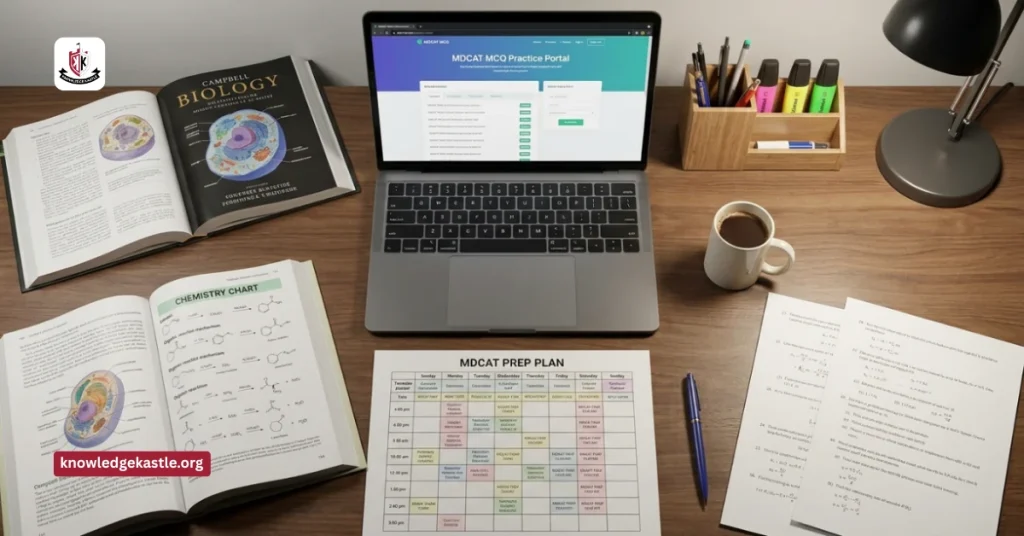
Preparing for the MDCAT without a clear roadmap is one of the biggest reasons students struggle, despite working hard. A structured MDCAT preparation timeline for 2026 helps you turn effort into results by providing direction for your study routine.
Complete the Syllabus on Time
A month-by-month plan ensures you cover all subjects, Biology, Chemistry, Physics, English, and Logical Reasoning, before the exam, instead of rushing at the end.
Avoid Last-Minute Pressure
Without planning, students often panic in the final weeks. A proper timeline allows you to finish your preparation early and focus on revision rather than cramming.
Improve Revision & Retention
Consistent revision is the key to scoring high. A structured plan gives you:
- Dedicated revision time
- Better memory retention
- Strong grip on concepts
Balance FSc Board Exams with MDCAT
For FSc students, managing both board exams and MDCAT is challenging. A smart MDCAT study plan for FSc students helps you:
- Study both without burnout
- Align board preparation with the MDCAT syllabus
- Save time by avoiding duplicate effort
Without a plan, even hardworking students can fall behind. But with a proper month-by-month MDCAT preparation schedule, you stay consistent, confident, and fully prepared for one of Pakistan’s most competitive exams.
Ideal Preparation Duration
For most students, the biggest mistake is either starting too late or trying to rush everything in a short time. Preparing for the MDCAT requires consistency over time, not last-minute effort.
Recommended Time: 6–8 Months
A 6–8 month MDCAT preparation timeline 2026 is considered ideal because it allows you to:
- Cover the complete syllabus thoroughly
- Build strong concepts in Biology, Chemistry, and Physics
- Practice enough MCQs and past papers
- Revise multiple times before the exam
This duration gives you a balanced approach, neither too rushed nor too slow.
Best Time to Start: Beginning of FSc Part 2
The most effective strategy is to begin your MDCAT study plan for FSc students at the start of FSc Part 2.
- You can align your board studies with MDCAT topics
- Many concepts overlap, saving time and effort
- You avoid pressure after board exams
A smart student doesn’t just study hard; they start at the right time and follow a clear plan.
Complete Month-by-Month MDCAT Study Plan

Many students feel overwhelmed because they don’t know where to start, how to manage time, or how to cover the entire syllabus effectively.
Month 1: Build Strong Basics
The first month of your MDCAT preparation timeline 2026 is all about laying a strong foundation. This stage is critical because everything you study later will depend on how well you understand these basic concepts, especially for the MDCAT.
Focus for Month 1:
- Understand the complete MDCAT syllabus
- Start conceptual learning (not cramming)
- Build clarity in fundamental topics
Subjects Plan:
Build a strong conceptual base that makes future topics easier and faster to learn. Goal: Build a strong foundation
- Biology: Cell structure, biomolecules
- Chemistry: Atomic structure
- Physics: Units & measurements
If your basics are weak, your entire preparation will struggle. But if your foundation is strong, the rest of your MDCAT study plan for FSc students becomes much smoother and more effective.
Month 2: Concept Strengthening
After building your basics, Month 2 of your MDCAT preparation timeline 2026 is about strengthening concepts and starting practical application for the MDCAT.
This is the stage where you move from just understanding topics to applying them through MCQs, a crucial step for success.
Focus for Month 2:
- Continue conceptual theory with a deeper understanding
- Start light MCQ practice alongside each topic
- Identify weak areas early
Subjects Plan
Don’t just solve MCQs, understand why an answer is correct or wrong. This habit will significantly improve your performance in the actual MDCAT.
- Biology: Enzymes, tissues
- Chemistry: Chemical bonding
- Physics: Motion & Laws
Solve 20–30 MCQs daily. Strengthen your concepts while developing MCQ-solving skills and accuracy.
Month 3: Syllabus Expansion
By Month 3 of your MDCAT preparation timeline 2026, you should shift from basic understanding to expanding your syllabus and improving speed + accuracy for the MDCAT.
This phase is where your preparation becomes more serious; you’ll cover high-weightage topics and increase your daily practice.
Focus for Month 3:
- Cover important and lengthy chapters
- Increase MCQ practice and speed
- Start identifying and fixing weak areas early
Subjects Plan:
Identify your weak areas early. Builds the foundation for advanced organic topics, focusing on concepts rather than rote learning.
- Biology: Human physiology
- Chemistry: Organic basics
- Physics: Work, energy, waves
At this stage, smart students don’t just study more; they analyze their performance and focus on improving weak points.
Month 4: First Full Revision
By Month 4, you should be transitioning from learning new topics to consolidating everything you’ve studied so far for the MDCAT.
This is a crucial turning point; many students fail not because they didn’t study, but because they didn’t revise effectively.
Focus for Month 4:
- Complete any remaining syllabus
- Begin your first full revision cycle
- Shift towards exam-oriented preparation
Revise All Subjects Once
Complete your syllabus and finish one full revision, while building exam temperament through timed practice.
- Go through Biology, Chemistry, and Physics systematically
- Focus on key concepts, formulas, and diagrams
- Use your short notes and error notebook
Aim to revise each subject at least once completely this month. This is where average students fall behind, but consistent revision and past-paper practice can quickly put you ahead of the competition.
Month 5: Practice & Testing Phase
By Month 5, your focus should shift almost entirely to testing, performance improvement, and MDCAT exam readiness.
At this stage, success depends less on how much you study and more on how well you perform under exam conditions.
Focus for Month 5:
- Improve speed and accuracy
- Strengthen time management skills
- Build exam temperament and confidence
Attempt Full-Length Tests
- Take 2–3 full-length mock tests per week
- Follow real exam timing (3 hours, 180 MCQs)
- Simulate actual exam conditions (no distractions)
This helps you adapt to pressure and improve stamina.
Daily Analysis (Most Important Step)
After each test:
- Review every mistake carefully
- Identify weak topics and revise them
- Track your score and accuracy trend
- Update your error notebook
Remember: Tests don’t improve you, analysis does.
Students who regularly take and analyze tests during this phase are the ones who score highly on the MDCAT, even if they weren’t top students earlier.
Daily Study Plan for MDCAT Students
A balanced daily routine is essential for success in the 2026 MDCAT preparation timeline. The key is consistency, not overload.
Biology (3–4 Hours)
Biology is the most important subject in MDCAT preparation, so it requires the highest daily time allocation.
Conceptual Understanding
- Read topics with full focus on “why and how.”
- Clear basic concepts before moving forward
Revision Work
- Revise diagrams, processes, and key terms daily
- Focus on human physiology and genetics regularly
MCQ Practice
- Solve topic-wise MCQs after each chapter
- Analyze mistakes and revise weak areas
Develop a strong conceptual base in Biology that helps you secure maximum marks in MDCAT 2026.
Chemistry (2–3 Hours)
Chemistry is one of the highest-scoring subjects in the MDCAT preparation timeline 2026, especially for the MDCAT. A consistent daily routine is essential to master both theory and problem-solving.
Concept Building
- Understand reactions instead of memorizing blindly
- Focus on why reactions happen and their conditions
Organic Chemistry Practice
- Study hydrocarbons, functional groups, and reaction types
- Practice step-by-step reaction mechanisms
Numericals & Formulas
- Solve physical chemistry numericals daily
- Revise important formulas (mole concept, equilibrium, etc.)
Develop strong conceptual clarity + reaction understanding + numerical accuracy to secure high marks in Chemistry for MDCAT 2026.
Physics (2–3 Hours)
Physics plays a key role in the 2026 MDCAT preparation timeline, as it tests both your conceptual understanding and numerical problem-solving skills.
Formula-Based Learning
- Learn all key formulas and revise them daily
- Understand where and how each formula is applied
Numerical Practice
- Solve numerical-based MCQs regularly
- Focus on accuracy and step-by-step solutions
Concept Understanding
- Avoid memorizing without logic
- Build a clear understanding of motion, forces, electricity, and related concepts.
Develop strong conceptual clarity and fast numerical-solving ability to maximize your Physics score in MDCAT 2026.
Common Mistakes to Avoid
Many students lose marks in the MDCAT not because they don’t study, but because they follow the wrong strategy. Avoiding these mistakes can significantly improve your performance in the MDCAT preparation timeline 2026.
Starting Preparation Late
Delaying your preparation reduces the time you have for concept building, MCQ practice, and revision. MDCAT requires consistent long-term preparation, not last-minute cramming.
Ignoring Weak Subjects
Students often focus only on strong areas and ignore difficult topics. This can seriously affect your overall score, especially in high-weightage subjects like Biology.
Skipping MCQ Practice
MDCAT is an MCQ-based exam, so without regular practice, you cannot improve:
- Speed
- Accuracy
- Exam confidence
Not Revising Regularly
Without revision, even well-studied topics are forgotten. Regular revision is essential to retain concepts and formulas.
Studying Without a Plan
Random studying leads to confusion and incomplete coverage of the syllabus. A structured MDCAT study plan for FSc students is necessary for effective preparation.
Success in MDCAT 2026 depends on smart preparation, consistency, and avoiding these common mistakes, not just hard work.
Conclusion
A well-planned MDCAT preparation timeline 2026 is the key to achieving success in the MDCAT. Instead of random studying, a structured month-by-month strategy helps you stay focused, cover the entire syllabus, and improve your performance step by step.
From building strong concepts in the early months to intensive MCQ practice and full-length mock tests in the final stages, every phase plays an important role in shaping your preparation. Consistency, discipline, and regular revision are what turn an average student into a top scorer.
Remember, MDCAT is not just about hard work; it is about smart planning, proper time management, and continuous improvement. If you follow a clear study plan, avoid common mistakes, and stay consistent, you can significantly increase your chances of securing admission in a top medical college in Pakistan.
Start early, stay consistent, and trust your preparation process, success in MDCAT 2026 will follow.
Frequently Asked Questions (FAQs)
1. How many months are required to prepare for MDCAT?
Most students need 6–8 months of consistent preparation for the MDCAT to cover the syllabus, practice MCQs, and revise properly.
2. What is the best time to start MDCAT preparation?
The ideal time is the start of FSc Part 2, so you can align board studies with MDCAT preparation.
3. Can I prepare for MDCAT in 3 months?
Yes, but it is very difficult. In 3 months, only revision and MCQ practice are possible, not full concept-building.
4. How should I balance FSc and MDCAT together?
Follow a daily schedule: study FSc topics first, then revise them for MDCAT MCQs.
5. How many MCQs should I practice daily?
On average, 100–150 MCQs per day are recommended for strong preparation and improved accuracy.
6. Is MDCAT preparation different for FSc students?
Yes, but not much. An MDCAT study plan for FSc students helps align syllabus overlap for better efficiency.
7. Which subject needs the most time in MDCAT?
Biology requires the most time because it carries the highest weightage (45%).
8. How important are mock tests in MDCAT preparation?
Mock tests are very important. They help improve speed, accuracy, and exam temperament.
9. What is the best revision strategy for MDCAT?
Revise weekly and monthly, focus on short notes, diagrams, formulas, and mistake analysis.
10. Can I prepare for MDCAT without coaching?
Yes, many students prepare successfully through self-study with a proper timetable, MCQ practice, and discipline.

0 Comments