






Chemistry is one of the most crucial subjects in the MDCAT, and it can significantly impact your overall score in the medical entry test. Many students underestimate it, but in reality, Chemistry contains several high-weightage, frequently repeated chapters that frequently appear in past papers under the exam system guided by the Pakistan Medical and Dental Council.
This guide highlights the most important MDCAT Chemistry High-Yield Chapters for 2026, including Organic Chemistry, Atomic Structure, Chemical Bonding, Thermochemistry, and Equilibrium. It also shares practical preparation strategies, revision tips, and chapter priorities to help students maximize their MDCAT Chemistry score.
That’s why focusing on the important chapters of MDCAT Chemistry is essential if you want to secure a top merit position in MBBS or BDS admissions. Instead of studying everything randomly, smart students prioritize MDCAT Chemistry high-yield topics and analyze MDCAT Chemistry past papers to identify the most repeated concepts.
In this guide, we will break down the high-yield chapters for MDCAT Chemistry 2026, covering both organic, inorganic, and physical chemistry topics that are most frequently tested. You’ll also learn which chapters you cannot skip, what topics appear again and again, and how to prepare Chemistry effectively for maximum marks.
If you are serious about scoring high in MDCAT, mastering these important Chemistry chapters for MDCAT is not optional; it’s essential.
Why is Chemistry Important in MDCAT?
Chemistry is one of the most critical subjects in the MDCAT, and it plays a major role in determining your overall merit for MBBS and BDS admissions under the system regulated by the Pakistan Medical and Dental Council.
Here’s why Chemistry is so important in MDCAT:
- Contributes Around 25% of the Paper: Chemistry holds a significant portion of the exam, making it a high-impact subject for scoring.
- Mix of Theory + Numerical MCQs: The subject includes both conceptual questions and numerical problems, especially in Physical Chemistry.
- High Repetition of Core Concepts: Many questions in MDCAT Chemistry repeated topics come directly from fundamental concepts and past papers.
- Direct Impact on Overall Merit Score: A strong Chemistry score can significantly improve your MDCAT aggregate and boost admission chances.
If you build a strong grip on Chemistry MDCAT high-yield topics, you can greatly increase your overall score and move closer to securing admission in a top medical college.
High-Yield MDCAT Chemistry Chapters You Must Focus On
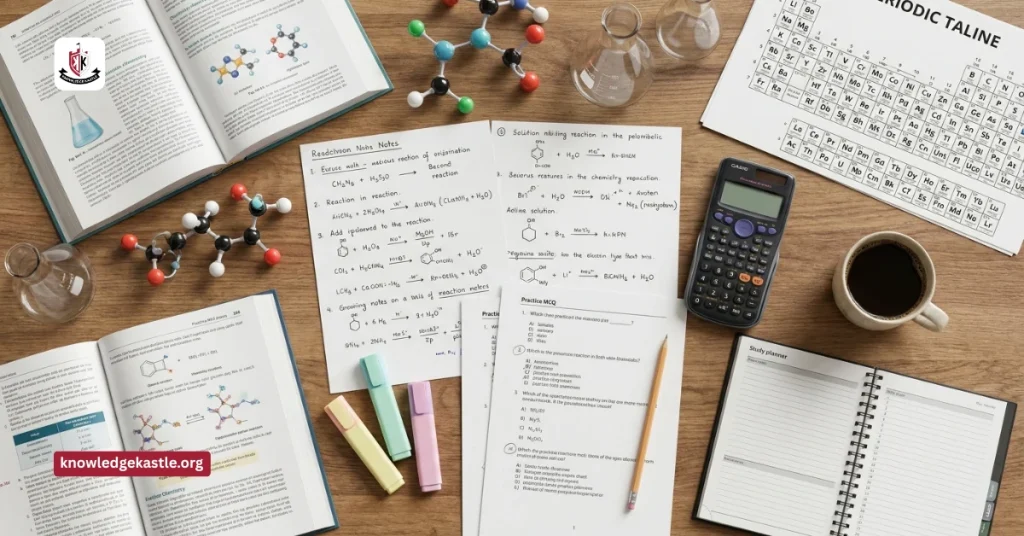
Chemistry in MDCAT is often considered tricky, but in reality, it becomes very scoring when you focus on the right chapters. Instead of trying to cover everything equally, smart students prioritize high-yield topics that appear repeatedly in past papers.
1. Atomic Structure
Atomic Structure is one of the most frequently tested MDCAT Chemistry important chapters in the MDCAT, and it is considered a foundation topic for almost all Chemistry concepts.
Key Areas:
Under the exam pattern followed by the Pakistan Medical and Dental Council, this chapter is a high-yield area and appears regularly in MDCAT Chemistry past papers.
- Subatomic particles (protons, neutrons, electrons)
- Electronic configuration (Aufbau principle, Hund’s rule)
- Quantum numbers (n, l, m, s)
- Atomic models (Rutherford, Bohr, modern atomic model)
Exam Focus:
- Direct conceptual MCQs from atomic theory
- Questions on electronic configuration and quantum numbers
- Comparisons of different atomic models
- Basic conceptual understanding rather than heavy numericals
Atomic Structure is a must-prepare chapter because it builds the base for many other Chemistry topics and is almost guaranteed to appear in MDCAT Chemistry exams every year.
2. Chemical Bonding
Chemical Bonding is one of the most important and high-scoring MDCAT Chemistry chapters in the MDCAT, and it is a core topic for understanding how atoms combine to form molecules.
Key Areas:
Under the exam pattern followed by the Pakistan Medical and Dental Council, this chapter is a high-yield area and frequently appears in MDCAT Chemistry past papers.
- Ionic vs covalent bonds
- Hybridization (sp, sp², sp³)
- Molecular geometry (shapes of molecules)
- VSEPR theory (Valence Shell Electron Pair Repulsion)
Exam Focus:
- Diagram-based MCQs on molecular shapes
- Conceptual questions on bond types and polarity
- Questions on hybridization and geometry of molecules
- Comparison-based MCQs (ionic vs covalent bonding)
Chemical Bonding is a must-prepare chapter because it forms the basis of understanding molecular structure and is frequently tested in MDCAT Chemistry exams every year.
3. States of Matter
States of Matter is a simple yet highly important MDCAT Chemistry chapter in the MDCAT, and it is frequently tested due to its mix of concepts and numericals.
Key Areas:
Under the exam pattern followed by the Pakistan Medical and Dental Council, this chapter is considered a high-yield topic and regularly appears in MDCAT Chemistry past papers.
- Gas laws (Boyle’s law, Charles’s law, Avogadro’s law)
- Ideal gas equation (PV = nRT)
- Properties of gases, liquids, and solids
Exam Focus:
- Numerical MCQs based on gas laws and formulas
- Conceptual questions on the behavior of gases
- Application-based questions using the ideal gas equation
- Comparisons between states of matter
States of Matter is a must-prepare chapter because it offers easy scoring opportunities, especially through numericals that are commonly repeated in MDCAT Chemistry exams.
4. Thermochemistry
Thermochemistry is a high-yield and scoring MDCAT Chemistry chapter in the MDCAT, especially known for its numerical-based questions and formula applications.
Key Areas:
Under the exam pattern followed by the Pakistan Medical and Dental Council, this chapter is considered a high-weightage topic and frequently appears in MDCAT Chemistry past papers.
- Enthalpy (heat content of a system)
- Heat of reaction
- Hess’s Law
- Exothermic vs endothermic reactions
Exam Focus:
- Numerical MCQs involving enthalpy calculations
- Application of Hess’s Law in problem-solving
- Conceptual questions on energy changes in reactions
- Identification of exothermic and endothermic processes
Thermochemistry is a must-prepare chapter because it offers high-scoring potential through numericals, but it requires strong formula practice and clear conceptual understanding to perform well in MDCAT Chemistry exams.
5. Chemical Equilibrium
Chemical Equilibrium is one of the most important conceptual MDCAT Chemistry chapters in the MDCAT, and it is frequently tested due to its application-based nature.
Key Areas:
Under the exam pattern followed by the Pakistan Medical and Dental Council, this chapter is considered high-yield and regularly appears in MDCAT Chemistry past papers.
- Le Chatelier’s Principle
- Equilibrium constant (Kc, Kp)
- Effect of temperature, pressure, and concentration on equilibrium
Exam Focus:
- Conceptual MCQs based on equilibrium shifts
- Questions involving the calculation or interpretation of Kc and Kp
- Application-based scenarios using Le Chatelier’s Principle
- Understanding how different factors affect the equilibrium position
Chemical Equilibrium is a must-prepare chapter because it is highly conceptual and repeatedly tested, making it a key area for scoring well in MDCAT Chemistry.
6. Acids, Bases, and Salts
Acids, Bases, and Salts is an easy yet highly scoring MDCAT Chemistry chapter in the MDCAT, making it a must-focus topic for quick marks.
Key Areas:
Under the exam pattern followed by the Pakistan Medical and Dental Council, this chapter is considered high-yield and frequently appears in MDCAT Chemistry past papers.
- pH and pOH calculations
- Strong vs weak acids and bases
- Neutralization reactions
Exam Focus:
- Direct theory-based MCQs
- Basic numerical questions related to pH and pOH
- Conceptual comparisons (strong vs weak acids/bases)
- Simple reaction-based questions
Acids, Bases, and Salts is a must-prepare chapter because it is simple, frequently repeated, and offers high-scoring potential with minimal effort if concepts are clear.
7. Organic Chemistry (Most Important Section)
Organic Chemistry is the most important and highest priority MDCAT Chemistry chapter in the MDCAT, and it carries significant weight in almost every exam.
Key Areas:
Under the exam pattern followed by the Pakistan Medical and Dental Council, this section is considered extremely high-yield and appears consistently in MDCAT Chemistry past papers.
- Hydrocarbons
- Functional groups
- Reaction mechanisms
- Alcohols, aldehydes, and ketones
Exam Focus:
- Conceptual MCQs based on reaction mechanisms
- Questions on the identification of functional groups
- Reaction-based MCQs (products and conditions)
- Application of concepts rather than rote memorization
Organic Chemistry is a must-prepare section because almost every MDCAT includes organic MCQs, making it one of the most scoring and unavoidable areas in the exam.
8. Hydrocarbons
Hydrocarbons are a core part of Organic Chemistry and a frequently tested MDCAT Chemistry chapter in the MDCAT.
Key Areas:
Under the exam pattern followed by the Pakistan Medical and Dental Council, this chapter is considered high-yield and regularly appears in MDCAT Chemistry past papers.
- Alkanes, alkenes, and alkynes
- Isomerism (structural and geometrical)
- Combustion reactions
Exam Focus:
- Questions on structures and naming (IUPAC basics)
- Conceptual MCQs on isomerism
- Reaction-based questions (especially combustion and addition reactions)
- Identification of different types of hydrocarbons
Hydrocarbons is a must-prepare chapter because it forms the base of Organic Chemistry and is frequently tested through structure-based and reaction-based MCQs in MDCAT.
9. Biochemistry
Biochemistry is an increasingly important MDCAT Chemistry chapter in the MDCAT, especially in recent papers, where its weightage has grown due to its medical relevance.
Key Areas:
Under the exam pattern followed by the Pakistan Medical and Dental Council, this chapter is considered high-yield and is now frequently appearing in MDCAT Chemistry past papers.
- Carbohydrates
- Proteins
- Lipids
- Enzymes
Exam Focus:
- Conceptual MCQs based on the structure and functions of biomolecules
- Questions on types and classification (e.g., monosaccharides, amino acids)
- Application-based questions related to biological processes
- Basic understanding of enzyme action and properties
Biochemistry is a must-prepare chapter because of its growing importance and strong connection with medical studies, making it a high-scoring and relevant topic in MDCAT Chemistry.
10. Electrochemistry
Electrochemistry is a high-yield and scoring MDCAT Chemistry chapter in the MDCAT, especially known for its numerical and concept-based questions.
Key Areas:
Under the exam pattern followed by the Pakistan Medical and Dental Council, this chapter is considered high-weightage and frequently appears in MDCAT Chemistry past papers.
- Redox reactions (oxidation and reduction concepts)
- Electrolytic and galvanic cells
- Electrode potential
Exam Focus:
- Numerical MCQs involving electrode potential and calculations
- Conceptual questions on redox reactions
- Understanding working and the differences between electrolytic and galvanic cells
- Application-based questions using formulas
Electrochemistry is a must-prepare chapter because it offers high-scoring potential through numericals, but it requires a strong understanding of formulas and concepts to perform well in MDCAT Chemistry exams.
Smart Strategy to Study Chemistry

To score high in the MDCAT Chemistry important chapters, you need a smart and focused approach rather than random study. Since the MDCAT is highly competitive under the Pakistan Medical and Dental Council, your preparation strategy must be efficient and result-oriented.
1. Focus on High-Yield Chapters First
Start with chapters that appear most frequently:
- Organic Chemistry
- Chemical Bonding
- Equilibrium
- Thermochemistry
This ensures maximum coverage in minimum time.
2. Build Strong Concepts
Avoid rote learning, especially in:
- Physical Chemistry (numericals)
- Organic reactions
Clear concepts help you solve tricky MCQs easily.
3. Practice MCQs Daily
- Solve MDCAT past papers
- Practice chapter-wise MCQs
- Review mistakes regularly
MCQ practice is the key to mastering the exam pattern.
4. Master Formulas & Reactions
- Make a formula sheet for numericals
- Revise organic reactions daily
- Memorize important equations
Quick recall saves time in the exam.
5. Follow a Revision Cycle
- Daily revision of studied topics
- Weekly revision of all chapters
- Focus on repeated questions
Revision prevents forgetting and strengthens memory.
6. Practice Time Management
- Attempt full-length mock tests
- Set time limits for MCQs
- Improve speed and accuracy
7. Avoid Common Mistakes
- Don’t skip “easy” chapters like acids/bases
- Don’t ignore numericals
- Don’t rely only on notes; practice is essential
A smart strategy for Chemistry is all about concept clarity + MCQ practice + regular revision. If you follow this approach consistently, you can easily master MDCAT Chemistry high-weightage topics and boost your overall score.
Conclusion
MDCAT Chemistry can become one of your strongest scoring subjects if you approach it with the right strategy. Instead of trying to cover every topic equally, focusing on high-yield chapters like Atomic Structure, Chemical Bonding, Organic Chemistry, Thermochemistry, and Equilibrium can give you a clear advantage.
These topics are not only frequently repeated in past papers but also form the foundation for many conceptual and numerical MCQs. With guidance from the syllabus set by the Pakistan Medical and Dental Council, students are expected to understand concepts rather than rely on rote memorization.
The key to success lies in consistent practice, strong conceptual clarity, and regular revision. Solving MCQs daily, mastering formulas, and revisiting important reactions will help you build confidence and accuracy.
In the end, smart preparation always beats hard preparation. Focus on what matters most, stay consistent, and you can turn Chemistry into a high-scoring subject in MDCAT.
FAQs
1. Which Chemistry chapters are most important for MDCAT?
The most important chapters include Atomic Structure, Chemical Bonding, Organic Chemistry, Thermochemistry, and Chemical Equilibrium. These topics are repeatedly tested and form the core of many MCQs.
2. How many Chemistry MCQs appear in MDCAT?
Typically, around 40–45 MCQs are from Chemistry, making it the second most important subject after Biology.
3. Is Organic Chemistry really important for MDCAT?
Yes, Organic Chemistry is one of the highest-scoring and most repeated sections. Many questions are directly based on reactions, functional groups, and concepts.
4. Are numerical questions common in MDCAT Chemistry?
Yes, numerical MCQs are common, especially from topics like Thermochemistry, States of Matter, and Electrochemistry. Practice is essential to solving them quickly.
5. Can I skip low-weight Chemistry chapters?
You should not completely skip any chapter, but you can prioritize high-yield topics first to manage your time effectively.
6. Is Chemistry harder than Biology in MDCAT?
Chemistry is usually considered more challenging than Biology because it involves both conceptual understanding and numerical problem-solving.
7. How should I start preparing for Chemistry for MDCAT?
Start with basic concepts like Atomic Structure and Chemical Bonding, then move toward Organic Chemistry and numerical topics.
8. Who designs the MDCAT Chemistry syllabus?
The MDCAT syllabus is set and approved by the Pakistan Medical and Dental Council to ensure a standardized exam across Pakistan.
9. What is the best way to revise Chemistry quickly?
Use short notes, formula sheets, reaction charts, and daily MCQ practice. Quick revision techniques help retain important concepts.
10. How can I score high in MDCAT Chemistry?
Focus on high-yield chapters, practice MCQs daily, understand concepts deeply, and revise regularly. Consistency is the key to scoring high.



0 Comments