



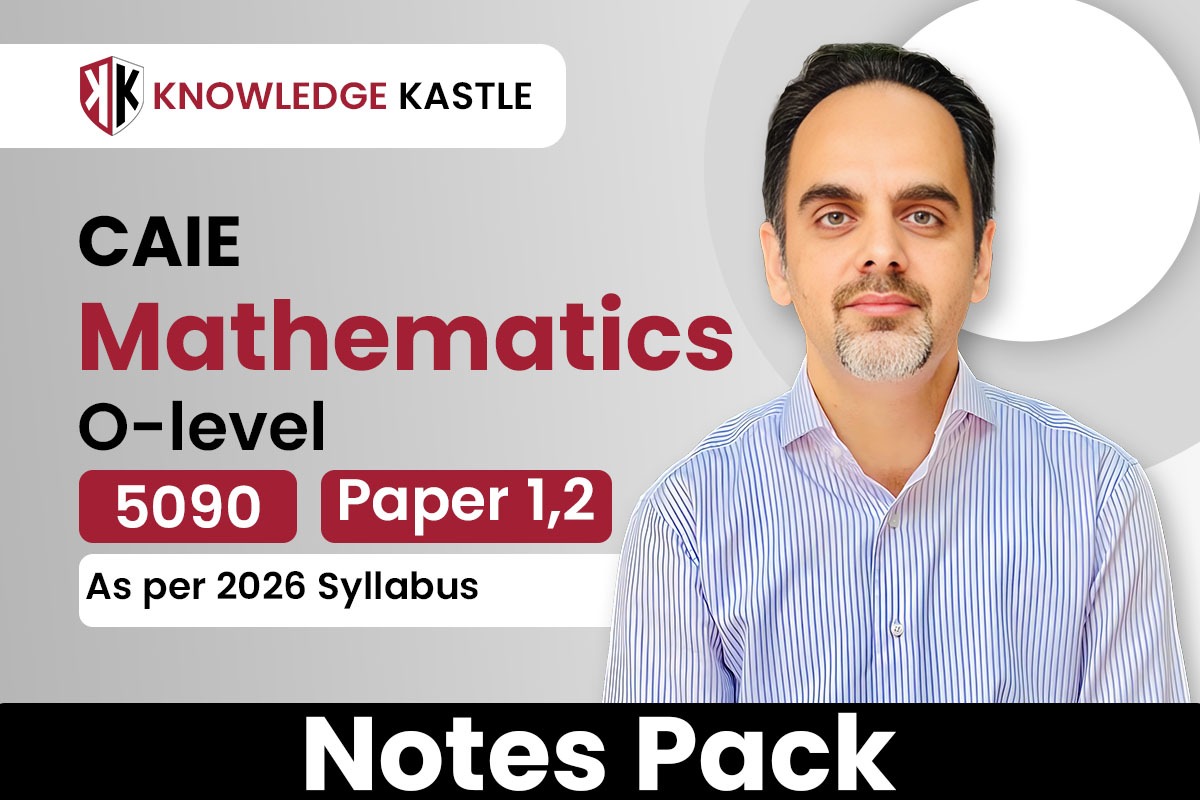
Mastering O Level Mathematics requires a strong understanding of core concepts, consistent practice, and familiarity with exam patterns. The Cambridge O Level Mathematics curriculum emphasizes problem-solving, analytical thinking, and application of mathematical principles, covering topics from algebra and geometry to statistics and probability.
Knowledge Kastle provides students with structured notes, topic-wise explanations, and past paper practice aligned with the Cambridge syllabus. With these resources, learners can strengthen their conceptual understanding, develop efficient problem-solving strategies, and practice exam-style questions with confidence.
By combining syllabus-focused notes, solved past papers, and expert guidance from Knowledge Kastle, students can approach their O Level Mathematics preparation in a focused and systematic way, maximizing their chances of achieving high scores.
Cambridge O Level Mathematics Syllabus Overview

The Cambridge O Level Mathematics syllabus is designed to develop a student’s problem-solving ability, logical reasoning, and numerical skills. It covers a wide range of topics to prepare learners for higher-level studies in mathematics, science, and engineering. The syllabus emphasizes both conceptual understanding and the application of mathematical techniques to real-world problems.
Core Topics in O Level Mathematics
The O Level Mathematics syllabus covers a wide range of essential topics designed to develop both conceptual understanding and exam-focused problem-solving skills. Cambridge students are expected to master these areas to confidently tackle both theory and application-based questions.
- Number and Algebra
Students begin with the fundamentals of numbers, including integers, fractions, decimals, and percentages. They then progress to algebraic concepts such as simplifying expressions, solving equations, and working with inequalities. A strong grasp of algebra is critical, as it forms the foundation for higher-level topics and problem-solving questions.
- Geometry and Trigonometry
This section focuses on the properties of angles, lines, and shapes, as well as coordinate geometry, including distance, midpoint, and gradients. Students also study trigonometric ratios, the sine and cosine rules, and basic trigonometric identities, which are frequently tested in exams.
- Mensuration
O Level Mathematics requires students to calculate areas, volumes, and surface areas of 2D and 3D shapes. Understanding formulas and applying them correctly in different contexts is key to scoring marks in both structured and word problems.
- Probability and Statistics
Students learn to represent, interpret, and analyze data using tables, charts, and graphs. Key statistical measures include mean, median, mode, and range, while probability questions cover simple events and combined probabilities. These skills are essential for real-life applications and exam problem-solving.
- Functions and Graphs
The syllabus introduces linear, quadratic, and exponential functions. Students practice plotting graphs, interpreting slopes and intercepts, and understanding how functions model real-world problems.
- Problem-Solving Techniques
Finally, word problems and logical reasoning form a major part of the curriculum. Students apply their knowledge of algebra, geometry, statistics, and functions to solve practical, exam-style problems. This develops analytical thinking and prepares learners for both structured and application-based questions.
By mastering these core topics and practicing consistently, O Level Mathematics students can build confidence and achieve high marks. Resources like Knowledge Kastle provide detailed notes, step-by-step solutions, and past paper exercises to strengthen understanding and exam readiness.
O Level Mathematics Paper Pattern
Understanding the paper pattern is essential for achieving high marks in Cambridge O Level Mathematics. Familiarity with question types, mark distribution, and time management helps students approach the exam strategically and confidently.
Exam Structure of O Level Mathematics
The Cambridge O Level Mathematics exam is carefully designed to test a student’s understanding of concepts, problem-solving skills, and ability to apply mathematics in practical situations. The exam is divided into two main papers, each with a specific focus and requirements.
Paper 1: Non-Calculator Paper
The Non-Calculator Paper tests a student’s ability to solve problems without a calculator, focusing on fundamental mathematical skills and logical reasoning.
- Purpose: To test students’ ability to perform calculations and solve problems without the aid of a calculator.
- Content: Covers fundamental topics such as number operations, algebra, geometry, basic statistics, and simple problem-solving.
- Question Types: Short-answer questions, structured problems, and basic word problems.
- Skills Assessed: Accuracy in calculation, logical reasoning, understanding of basic mathematical concepts, and step-by-step problem-solving.
Practice performing calculations manually, check each step carefully, and show clear working to earn partial marks if the final answer is incorrect.
Paper 2: Calculator Paper
The Calculator Paper allows students to use a calculator for more complex problems, enabling them to focus on applying concepts rather than manual computation.
- Purpose: To assess students’ skills in solving more complex problems using a calculator.
- Content: Includes algebra, functions and graphs, trigonometry, mensuration, probability, and statistics.
- Question Types: Structured multi-step questions, graph plotting, applied word problems, and problem-solving scenarios.
- Skills Assessed: Ability to apply concepts in practical contexts, interpret data, analyze graphs, and solve multi-stage problems.
Paper 1 focuses on manual calculation and accuracy, while Paper 2 emphasizes application, problem-solving, and calculator-based computation. Both papers require practice, time management, and clear working. Using resources like Knowledge Kastle helps students prepare for both papers with structured exercises, past papers, and topic-wise guidance.
Recommended Cambridge O Level Mathematics Books & Notes
Choosing the right study materials is crucial for success in Cambridge O Level Mathematics. The syllabus covers a wide range of topics, from basic algebra to advanced functions, geometry, and statistics. Using high‑quality books and clear notes helps students build strong concepts, practice extensively, and perform confidently in both non‑calculator and calculator papers.
Here’s a curated list of recommended books and note resources:
1. Cambridge Official Syllabus Booklet
The official syllabus booklet from the exam board outlines:
- Topic coverage
- Assessment objectives
- Weightage of each section
- Exam format
It’s the first resource every student should study to understand what the exam expects.
2. Cambridge O Level Mathematics Textbooks
These are the core study texts that follow the Cambridge syllabus closely:
- Cambridge O Level Mathematics Coursebook: A comprehensive text with clear explanations, worked examples, and practice questions arranged by topic.
- Cambridge O Level Mathematics Workbook: Offers additional exercises to practice at your own pace, ideal for building confidence.
Choose editions that are updated according to the latest Cambridge syllabus code for O Level Mathematics.
3. Revision Guides & Companions
Revision guides are great for a quick review before exams.
- O Level Mathematics Revision Guide: Revision guides break down key concepts into short, easy‑to‑digest explanations, ideal for last‑minute revision before exams. These guides often highlight formulae, common question types, and tips to avoid mistakes.
- Formulae and Tables Booklet (Cambridge): Cambridge provides an official booklet of mathematical formulae and tables. Students should memorize key areas but also know when and how to use this booklet effectively during exams.
These help reinforce learning from the main textbooks without being overwhelming.
4. Past Papers & Mark Scheme Compilations
Practicing past papers is one of the most effective ways to prepare. Books or PDFs with past O Level Mathematics papers and official mark schemes are essential. Solving past papers builds familiarity with:
- question formats
- timing strategies
- mark allocation
- examiner expectations
Your study set should include:
- Official Cambridge past papers (last 8–10 years)
- Corresponding mark schemes
- Examiner reports
Benefits of using these compilations:
- Understand how questions are framed
- Learn how marks are distributed
- Identify common mistakes students make
- Familiarize yourself with examiner expectations
Students benefit greatly from comprehensive notes that summarize key ideas for each topic, such as number theory, algebra, functions, trigonometry, mensuration, and statistics.
Importance of Past Papers in O-Level Mathematics

Solving past papers is one of the most effective strategies for success in Cambridge O Level Mathematics. While understanding the syllabus and practicing exercises is important, past papers give students a realistic view of exam expectations and help develop exam-ready skills.
Familiarity with Exam Format
Past papers help students become accustomed to the structure of questions, mark allocation, and common problem types. For example:
- Paper 1 questions focus on non-calculator calculations, basic algebra, and straightforward geometry.
- Paper 2 questions include multi-step problems, functions, trigonometry, statistics, and applied scenarios.
By practicing past papers, students know what to expect and can approach each question with confidence.
Time Management
Many students struggle to complete all the questions within the allotted time. Working through past papers under timed conditions allows students to:
- Gauge how much time to allocate per question
- Identify questions that require more thought
- Build speed and efficiency for both short-answer and long-answer problems
Understanding Examiner Expectations
Reviewing mark schemes along with past papers teaches students how examiners award marks:
- Partial credit is often given for correct working, even if the final answer is wrong
- Clear, step-by-step solutions are rewarded
- Proper presentation and logical reasoning can make a significant difference
This insight helps students structure their answers for maximum marks.
Identifying Weak Areas
Repeated practice highlights topics where mistakes are common, such as:
- Algebraic manipulations
- Trigonometry calculations
- Word problems or multi-step questions
- Data interpretation in statistics
Students can then focus their revision on these areas to improve overall performance.
Building Confidence
Working through multiple past papers reduces exam anxiety. Familiarity with question patterns and repeated exposure to challenging problems helps students stay calm, think logically, and execute solutions accurately during the real exam.
At Knowledge Kastle, students receive:
- Solved past papers
- Step-by-step solutions
- Examiner insights and common pitfalls
Regular past paper practice ensures students are exam-ready and able to tackle complex questions effectively.
Transition from O Level to A Level Mathematics
A strong foundation in O-level Mathematics is essential for A-level Mathematics. Key skills developed include:
- Algebraic manipulation and advanced equations
- Trigonometric and calculus applications
- Analytical thinking for problem-solving
- Graphical interpretation of data
Knowledge Kastle guides students through O-level preparation in a way that naturally builds the skills needed for higher-level mathematics.
How O-Level Prepares Students for A-Level
Strong performance in O Level Mathematics provides the essential foundation for success at A Level:
- Mastery of algebra and functions enables students to tackle advanced topics like calculus and logarithms.
- Understanding geometry, trigonometry, and coordinate geometry develops the spatial reasoning needed for complex problems.
- Familiarity with statistics and probability provides a base for higher-level data analysis and decision-making tasks.
- Problem-solving practice cultivates logical thinking, essential for handling A Level questions.
O and A Level expands to detailed function analysis, transformations, gradients, and applications in calculus.
How O-Level Prepares Students for A-Level
Strong performance in O Level Mathematics provides the essential foundation for success at A Level:
- Mastery of algebra and functions enables students to tackle advanced topics like calculus and logarithms.
- Understanding geometry, trigonometry, and coordinate geometry develops the spatial reasoning needed for complex problems.
- Familiarity with statistics and probability provides a base for higher-level data analysis and decision-making tasks.
- Problem-solving practice cultivates logical thinking, essential for handling A Level questions.
By solidifying O Level skills and gradually introducing A Level topics, students can make a smooth and confident transition, setting the stage for success in more advanced mathematics studies.
Cambridge Resources for O Level Mathematics
To succeed in O Level Mathematics Cambridge, it’s important to use authentic, high‑quality resources that reflect the latest syllabus, exam format, and assessment standards. These resources support students in understanding concepts deeply, practising effectively, and performing confidently in exams, especially when paired with guidance from Knowledge Kastle.
1. Official Cambridge Syllabus & Subject Guide
The official syllabus from Cambridge Assessment International Education is the blueprint for the entire course. It outlines:
- Topic coverage and objectives
- Weightage of each section
- Assessment criteria and format
- Recommended study hours
Knowing the syllabus helps you prioritize topics, plan revisions, and avoid studying irrelevant material. It’s your roadmap for targeted preparation.
2. Cambridge Specimen Papers
Cambridge specimen papers are official example papers released by the exam board. They reflect:
- Exam structure (calculator and non‑calculator papers)
- Question types you’re likely to encounter
- Marking style and expected answers
Solve specimen papers early in your preparation to familiarize yourself with question wording and expectations.
3. Cambridge Past Papers and Mark Schemes
Past papers are among the most powerful tools for exam preparation. Cambridge provides:
- Official past papers from previous years
- Examiner‑approved mark schemes
- Examiner reports (analysis of student performance)
Knowledge Kastle incorporates past papers into practice sessions with step‑by‑step solutions and expert feedback.
4. Examiner Reports
Examiner reports explain common student mistakes and what examiners look for in answers. They provide:
- Insight into high‑scoring responses
- Clarification on expected steps
- Notes on common misconceptions
Learning what examiners prioritize helps boost marks in both method and presentation.
5. Cambridge Approved Textbooks
Official Cambridge‑endorsed textbooks are written specifically for the O Level Mathematics syllabus. They usually include:
- Clear concept explanations
- Worked examples
- Practice exercises
- Progress checks
Look for textbooks marked Cambridge endorsed to ensure they align with the latest exam standards.
Benefits of Studying O-Level Mathematics with Knowledge Kastle
Preparing for O Level Mathematics Cambridge can be challenging without the right guidance and resources. Knowledge Kastle offers a structured approach that helps students build strong concepts, improve problem-solving skills, and achieve high marks. Here are the key benefits of studying O Level Mathematics with Knowledge Kastle:
1. Comprehensive Syllabus Coverage
Knowledge Kastle ensures that every topic in the O Level Mathematics Cambridge syllabus is covered thoroughly:
- Algebra, geometry, trigonometry, and statistics
- Problem-solving and applied mathematics
- Calculator and non-calculator paper topics
Benefit: Students gain a clear understanding of all essential topics without missing key areas that are often tested in exams.
2. High-Quality Notes and Resources
Students receive:
- Topic-wise explained notes
- Step-by-step solved examples
- Practice exercises and formula sheets
Benefit: Simplifies complex concepts and provides quick reference materials for revision.
3. Structured Past Paper Practice
Knowledge Kastle integrates Cambridge past papers into learning:
- Timed practice sessions to simulate exam conditions
- Solutions aligned with mark schemes
- Examiner tips for common mistakes
Benefit: Students become familiar with exam patterns, question types, and marking expectations, improving confidence and performance.
4. Personalized Feedback and Progress Tracking
- Weak areas are identified and addressed
- Targeted exercises are provided to strengthen skills
- Regular progress reports help track improvement
Benefit: Students focus on their personal learning gaps, ensuring efficient preparation and better results.
5. Expert Guidance and Workshops
Knowledge Kastle offers expert-led sessions that focus on:
- Problem-solving strategies
- Analytical thinking and logical reasoning
- Quick calculation techniques for faster solving
Benefit: Students learn how to approach challenging questions effectively, boosting both speed and accuracy.
Conclusion
O Level Mathematics is a core subject that develops critical thinking, problem-solving skills, and analytical abilities essential for academic success. Mastery of O Level Mathematics Cambridge lays the foundation for A Level Mathematics and higher studies in STEM-related fields.
With structured preparation using Knowledge Kastle resources, comprehensive notes, solved and unsolved exercises, past papers with examiner insights, formula sheets, and personalized guidance, students can confidently tackle every topic in the syllabus. Regular practice, focused revision, and expert support ensure strong conceptual understanding, improved accuracy, and excellent exam performance.
By combining Cambridge-approved materials with Knowledge Kastle’s tailored approach, students not only achieve high grades in O Level Mathematics but also build the skills and confidence needed for advanced mathematical studies and future academic success.
FAQs
1. Is O-Level Mathematics difficult?
O Level Mathematics can be challenging, but with consistent practice, proper guidance, and the right resources, students can master all topics and score high marks. Knowledge Kastle provides structured learning to make the subject manageable.
2. How many papers are there in O Level Mathematics Cambridge?
Typically, there are two papers:
- Paper 1: Without a Calculator
- Paper 2: With Calculator
Both papers test core mathematical concepts, problem-solving skills, and logical reasoning.
3. Are past papers important for preparation?
Yes, past papers are essential. They help students understand exam patterns, question types, and time management. Knowledge Kastle provides solved past papers, mark schemes, and examiner tips.
4. How can I improve my problem-solving skills?
Regular practice of exercises, step-by-step solutions, and tackling past paper questions improve problem-solving. Knowledge Kastle’s structured approach focuses on strategies and methods for different types of questions.
5. Are formula sheets provided in the exam?
Yes, some formulae are provided in calculator papers. However, students should memorize frequently used formulas for speed and accuracy. Knowledge Kastle provides curated formula sheets for quick revision.
6. How much time should I spend preparing for O Level Mathematics?
Consistent daily practice over several months is recommended. A structured schedule that combines note review, exercises, and past paper practice ensures thorough preparation.
7. Can I prepare without coaching?
Yes, self-study is possible, but structured guidance from Knowledge Kastle accelerates learning, clarifies doubts, and ensures efficient preparation aligned with O Level Mathematics Cambridge standards.
8. What topics are most important for scoring high marks?
Core topics include:
- Algebra (equations, inequalities)
- Geometry and Trigonometry
- Statistics and Probability
- Mensuration and Functions
Regular practice of these topics greatly improves exam performance.
9. How does O Level Mathematics help in A Level Mathematics?
It builds a strong foundation in algebra, functions, trigonometry, and problem-solving, which are essential for A Level Mathematics topics like calculus, vectors, and advanced algebra. Knowledge Kastle emphasizes this progression.
10. How does Knowledge Kastle support O-Level Mathematics preparation?
Knowledge Kastle provides:
- Comprehensive notes and formula sheets
- Step-by-step solved examples
- Past papers with examiner feedback
- Workshops and problem-solving strategies
- Personalized guidance to strengthen weak areas
This combination ensures students are fully prepared, confident, and ready to excel in exams.
