





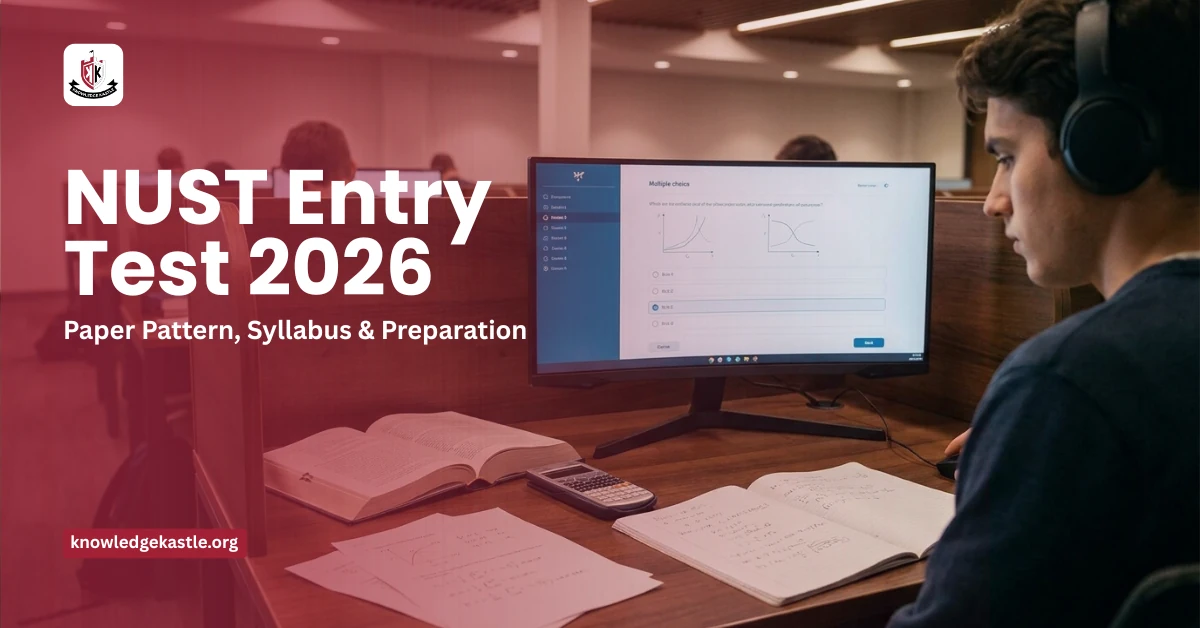
The NUST Entry Test 2026 guide explains the latest NET paper pattern, syllabus, merit calculation, recommended books, and practical preparation strategies. It helps students understand the exam structure, focus on high-weight topics, improve time management, and maximize their chances of securing admission to NUST.
Getting admission into National University of Sciences and Technology is a dream for thousands of students in Pakistan, but success largely depends on your performance in the NUST Entry Test 2026, commonly known as NET (NUST Entrance Test). Since NUST is one of the most competitive universities in the country, understanding the paper pattern, syllabus, and preparation strategy is essential for securing admission.
In this complete guide, we will explain everything you need to know about NUST NET 2026, including the latest paper pattern, subject-wise syllabus, marks distribution, eligibility criteria, and smart preparation techniques. Whether you are applying for engineering, computer science, business studies, or social sciences, this article will help you understand how the NUST admission test 2026 works and how to prepare effectively.
If you are searching for answers like “What is the syllabus of NUST Entry Test 2026?”, “How difficult is NUST NET?”, or “How can I prepare for NUST NET at home?”, this guide will provide practical and beginner-friendly solutions.
By the end of this article, you will have a clear roadmap for NUST NET preparation 2026 and a better understanding of how to maximize your chances of admission into one of Pakistan’s top universities.
What is the NUST Entry Test (NET)?
The NUST Entry Test 2026, commonly known as NET (NUST Entrance Test), is the official undergraduate admission test conducted by the National University of Sciences and Technology for students seeking admission into various undergraduate programs.
This test is designed to evaluate students’ academic knowledge, analytical ability, and problem-solving skills for different disciplines offered by NUST.
NET is used for admissions in:
- Engineering
- Computer Science
- Business Studies
- Social Sciences
- Applied Sciences
One of the biggest advantages of the NUST admission system is that students can attempt NET multiple times in a year through different NET series, and the highest score is considered for merit calculation.
The NUST Entry Test is one of the most competitive university entrance exams in Pakistan, and a strong NET score significantly improves your chances of admission into top undergraduate programs at NUST.
NUST Entry Test 2026 Paper Pattern

Understanding the paper pattern of the NUST Entry Test 2026 (NET) is extremely important for smart preparation. The test is designed to evaluate a student’s academic concepts, analytical thinking, and problem-solving ability under time pressure.
The National University of Sciences and Technology conducts different NET categories for engineering, business studies, computer science, and social sciences, but the basic structure remains similar.
General NET Paper Structure
The NUST NET is a multiple-choice question (MCQ)-based exam conducted on a computer-based system.
Key Features:
- Total Questions: Approximately 200 MCQs
- Time Duration: 3 hours
- Question Type: Multiple Choice Questions (MCQs)
- Negative Marking: No negative marking in most categories
- Computer-Based Test (CBT) format
Speed and accuracy are both very important because of the limited time.
Engineering & Computer Science NET Pattern
For engineering and computer science applicants, the test usually includes:
| Subject | Approximate Weightage |
| Mathematics | Highest portion |
| Physics | Major portion |
| Chemistry / Computer Science | Moderate portion |
| English | Small portion |
| Intelligence / Analytical Reasoning | Small portion |
Mathematics and Physics carry the highest weightage, so strong conceptual preparation is essential.
Business & Social Sciences NET Pattern
For business studies and social sciences programs, the test focuses more on reasoning and verbal skills.
Subjects Included:
- Mathematics / Basic Math
- English
- Intelligence / Analytical Reasoning
- Basic Subject Knowledge (depending on program)
English and analytical reasoning play a major role in these categories
Mathematics Syllabus for NET
Mathematics is the most important and highest-weightage section in the NUST Entry Test 2026 (NET) for engineering and computer science students. A strong performance in Mathematics can significantly improve your overall score and merit position.
Under the admission criteria of National University of Sciences and Technology, Mathematics carries the largest portion of marks in the engineering NET, making it the most critical subject for preparation.
High-Weight Topics:
Mathematics carries the highest marks in NET Engineering, mastering this section can greatly increase your chances of securing admission into top engineering programs at NUST.
- Algebra: Functions, sequences, matrices, logarithms, and equations
- Trigonometry: Trigonometric identities, graphs, and applications
- Calculus: Limits, differentiation, integration, and their applications
- Analytical Geometry: Lines, circles, parabola, ellipse, and hyperbola
- Probability: Probability rules, permutations, combinations, and statistics
- Complex Numbers: Operations, polar form, and De Moivre’s theorem
Most Mathematics questions in NET are conceptual and problem-solving based, so students should focus on understanding formulas, practicing MCQs, and improving calculation speed instead of rote memorization.
Physics Syllabus for NET
Physics is one of the most important sections in the NUST Entry Test 2026 (NET), especially for engineering students. The Physics portion mainly tests your conceptual understanding, analytical thinking, and ability to apply formulas in problem-solving situations.
In recent years, students appearing in the National University of Sciences and Technology NET have reported that conceptual and application-based MCQs are increasing instead of simple memorization questions.
Important Topics:
A strong grip on Physics concepts can significantly improve your NET score, especially in engineering and computer science admission tests.
- Motion & Force: Laws of motion, vectors, circular motion, and dynamics
- Work & Energy: Work-energy theorem, conservation of energy, and power
- Electricity: Current electricity, circuits, capacitance, and electromagnetism
- Waves & Optics: Wave motion, interference, diffraction, reflection, and refraction
- Modern Physics: Atomic structure, nuclear physics, relativity, and semiconductor concepts
Most NET Physics questions are conceptual rather than direct theory-based, so students should focus on understanding principles, formulas, and real-world applications instead of rote learning.
English Portion in NET
The English section in the NUST Entry Test 2026 (NET) is designed to evaluate a student’s language skills, vocabulary, and reading comprehension abilities. Although it carries lower weightage compared to Mathematics and Physics, it can still contribute important marks to your overall score.
In the admission test conducted by the National University of Sciences and Technology, the English portion is usually straightforward for students who practice regularly.
Common Topics in English Portion:
Here are some common topics:
- Vocabulary: Synonyms, antonyms, and word meanings
- Sentence Correction: Grammar, sentence structure, and error detection
- Reading Comprehension: Short passages followed by MCQs
- Analogy & Word Usage: Logical word relationships and proper usage
- Basic Grammar: Tenses, prepositions, active/passive voice, and punctuation
The English portion is considered a scoring area for students who prepare consistently. Even a few extra marks in English can improve your overall NET merit position significantly.
Merit Calculation for NUST Admissions
Admission into National University of Sciences and Technology is based on a merit formula that combines your academic performance and NET score. Understanding this calculation is very important because even small improvements in marks can significantly affect your final merit position.
For most undergraduate programs, NUST calculates merit using the following components:
Merit Components:
- NUST Entry Test (NET): Highest weightage
- FSc / A Level / Equivalent Marks: Important academic contribution
- Matric / O Level Marks: Smaller percentage in overall merit
General Merit Formula
In most cases, the merit is approximately calculated as:
- 75% NET Score
- 15% FSc Part-I / Equivalent
- 10% Matric / O Level
The exact formula may vary slightly depending on the program and admission policy updates.
Best Preparation Strategy for NUST NET 2026

Preparing for the NUST Entry Test 2026 (NET) requires smart planning, concept clarity, and consistent practice. Since admission to National University of Sciences and Technology is highly competitive, students need a focused preparation strategy to achieve a high score.
The key to success in NET is not just hard work, it is smart and organized preparation.
1. Understand the NET Paper Pattern First
Before starting preparation, carefully understand:
- Subject-wise weightage
- MCQ format
- Time duration
- Important high-scoring topics
Knowing the exam structure helps you study more efficiently.
2. Build Strong Concepts
NET is becoming increasingly conceptual, especially in Mathematics and Physics.
Focus on:
- Understanding formulas and concepts
- Problem-solving techniques
- Application-based MCQs
Avoid rote memorization and focus on conceptual learning.
3. Practice MCQs Daily
Daily practice is essential for improving speed and accuracy.
Recommended Strategy:
- Solve topic-wise MCQs
- Practice mixed question sets
- Analyze mistakes regularly
Consistency is one of the biggest factors behind high NET scores.
4. Focus on High-Weight Topics
Spend more time on chapters that appear frequently in NET.
For Engineering NET:
- Mathematics (highest priority)
- Physics conceptual chapters
- Analytical reasoning and English basics
Smart preparation means focusing on high-return topics first.
5. Solve Past Papers and Mock Tests
Past papers help students understand:
- Repeated question patterns
- Difficulty level
- Time management challenges
Full-length mock tests simulate real exam pressure and build confidence.
6. Improve Time Management
NET contains a large number of MCQs in limited time.
Best Time Management Tips:
- Don’t spend too long on one question
- Skip difficult questions initially
- Return later if time allows
Speed + accuracy = high NET score.
7. Create a Daily Study Schedule
A proper study timetable improves consistency and reduces stress.
Suggested Routine:
- Mathematics practice daily
- Physics concept revision
- English vocabulary and reasoning practice
- Weekly mock tests
Little daily progress creates major long-term improvement.
8. Use the Right Study Resources
Choose quality resources instead of studying from too many books.
Recommended Resources:
- FSc textbooks
- NET preparation books
- MCQ practice materials
- Online mock tests and past papers
Avoid wasting time on irrelevant or overly difficult material.
Success in NUST NET 2026 comes from a combination of concept clarity, regular MCQ practice, mock testing, and disciplined preparation. Students who stay consistent and follow a smart strategy greatly improve their chances of admission into NUST.
Best Books for NUST NET Preparation
Choosing the right study material is extremely important for success in the NUST Entry Test 2026 (NET). Since the test is highly conceptual and MCQ-based, students should use resources that strengthen both concepts and problem-solving skills.
For preparation of the admission test conducted by National University of Sciences and Technology, most high-scoring students rely on a combination of textbooks, MCQ practice books, and mock tests.
Recommended Resources:
- FSc Textbooks: The majority of NET questions are based on the FSc syllabus, especially for Mathematics, Physics, and Chemistry
- OETP NET Preparation Books: One of the most popular resources for topic-wise MCQs and practice tests
- KIPS FUNG Series: Helpful for conceptual learning, difficult MCQs, and advanced preparation
- Past Papers and Mock Tests: Essential for understanding question patterns, time management, and repeated topics
Always combine conceptual study with MCQ practice. Reading theory alone is not enough for NET success, regular problem-solving practice is equally important.
Using the right books with a consistent study plan can significantly improve your confidence, speed, and overall NET score.
Conclusion
The NUST Entry Test 2026 (NET) is one of the most important steps for students aiming to secure admission in top programs at the National University of Sciences and Technology. Since it plays a major role in merit calculation, a strong performance in NET can significantly improve your chances of getting into engineering, computer science, business, or social sciences programs.
Success in NET is not just about studying hard; it is about understanding the paper pattern, focusing on high-weight topics, practicing MCQs regularly, and managing time effectively. Students who follow a structured preparation strategy and use the right resources usually perform much better.
With consistent effort, smart preparation, and proper planning, you can achieve a high score in NET 2026 and secure admission in one of Pakistan’s most prestigious universities.
FAQs
1. What is the NUST Entry Test (NET)?
The National University of Sciences and Technology NET is the official undergraduate admission test for programs like Engineering, Computer Science, Business Studies, and Social Sciences.
2. Can students attempt NET multiple times?
Yes, students can appear in multiple NET series during the year, and the highest score is considered for merit.
3. What subjects are included in NET Engineering?
NET Engineering mainly includes Mathematics, Physics, Chemistry/Computer Science, English, and Intelligence.
4. Is NET harder than MDCAT?
Both tests are different. NET is generally more mathematics and analytical-reasoning-focused, while MDCAT emphasizes biology and medical sciences.
5. What is the paper pattern of NUST NET 2026?
The test is MCQ-based, computer-based, and usually contains around 200 questions to be solved within 3 hours.
6. How much weightage does NET carry in merit calculation?
NET usually carries around 75% weightage in the final merit formula.
7. Which books are best for NUST NET preparation?
FSc textbooks, OETP books, KIPS FUNG series, and past papers are among the most recommended resources.
8. How can I prepare for NET at home?
You can prepare through self-study, online lectures, MCQ practice, past papers, and regular mock tests.
9. Is there negative marking in NET?
In most NET categories, there is no negative marking.
10. What score is considered good in NUST NET?
A high NET score depends on the program, but generally, a strong score greatly improves chances for competitive fields like engineering and computer science.





0 Comments