

If you have completed your O Levels and plan to continue your higher education in Pakistan, understanding the IBCC equivalence for O Level students is extremely important. Without an equivalence certificate, your international qualification cannot be properly converted into the local grading system used for university admissions.
That is why thousands of students search for O Level IBCC equivalence in Pakistan, how to get IBCC equivalence for O Level, and the complete IBCC equivalence process for O Level students every year.
In Pakistan, the equivalence system is managed by the Inter Board Committee of Chairmen, which issues the official IBCC equivalence certificate for O Level students. This certificate converts Cambridge grades into local marks, enabling students to apply to colleges and universities under the same merit system as Matric students.
Many students often have questions such as whether IBCC equivalence is necessary for university admission, what documents are required, and how long the process takes. This complete guide explains the step-by-step process for IBCC equivalence for O Level students, including the application process, required documents, and tips to avoid delays.
What is IBCC Equivalence?
IBCC equivalence for O Level students is an official certification process in Pakistan that converts international qualifications, such as Cambridge O Levels, into an equivalent local grading system. This allows students to apply for admission in Pakistani colleges and universities under the same merit system as Matric and Intermediate students.
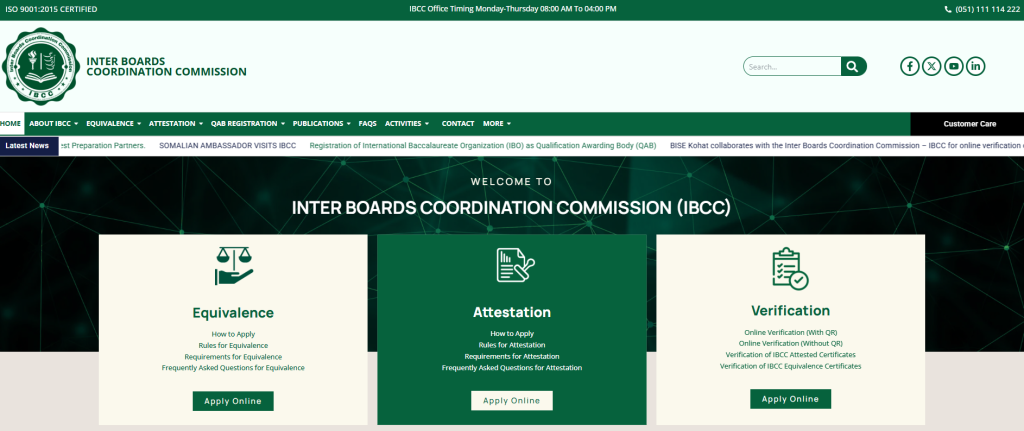
The equivalence process is managed by the Inter Board Committee of Chairmen, which evaluates foreign qualifications and issues an IBCC equivalence certificate for O Level students.
Purpose of IBCC Equivalence:
The IBCC equivalence for O Level students is designed to ensure that international qualifications are properly understood and fairly compared within Pakistan’s education system. It plays an important role in university admissions, especially for students coming from Cambridge or other foreign boards.
- Converts O Level grades into Matric (SSC) equivalent marks for fair comparison
- Allows students with international qualifications to apply for colleges and universities in Pakistan
- Ensures a standardized merit system between local and foreign education systems
- Helps universities evaluate students under a uniform grading structure
- Supports admission processes for medical, engineering, and general degree programs
- Provides official recognition of Cambridge O Levels and other foreign certificates
The system is managed by the Inter Board Committee of Chairmen, which evaluates academic records and converts them into a standardized local grading format.
Why is IBCC Equivalence Important?
The IBCC equivalence for O Level students is an essential requirement in Pakistan because it ensures that international qualifications are properly recognized and fairly compared with the local education system. It plays a key role in university admissions, especially for students applying after Cambridge O Levels or other foreign qualifications.
The system is managed by the Inter Board Committee of Chairmen, which is responsible for evaluating academic records and converting them into a standardized local grading format.
- Converts O Level grades into Matric (SSC) equivalent marks for fair and transparent comparison
- Allows students with international qualifications to apply for colleges and universities in Pakistan without discrimination
- Ensures a standardized merit system between local (FSc/Matric) and international education systems
- Helps universities evaluate all applicants under a uniform grading structure for merit calculation
- Supports admission processes for medical, engineering, and general degree programs across Pakistan
- Provides official recognition of Cambridge O Levels and other foreign certificates for academic and career purposes
Overall, IBCC equivalence is important because it ensures that every student, whether from a local or international background, is assessed fairly under the same academic standards in Pakistan.
Documents Required for IBCC Equivalence
Before starting the IBCC equivalence application for O Level students, it is important to carefully gather all the required documents. Missing or incorrect documents can delay your application process, so students should prepare everything in advance before applying to the Inter Board Committee of Chairmen.
Required Documents:
- Original O Level result certificate issued by Cambridge Assessment International Education or Pearson Edexcel
- CNIC or B-Form for identity verification
- Recent passport-size photographs with a clear background
- Completed Matric equivalence application form
- Attested photocopies of all required documents
- School leaving certificate (if applicable or required by IBCC)
Make sure all documents are properly attested and clearly readable, as incomplete submissions can delay your O Level IBCC equivalence in Pakistan process. Proper preparation helps ensure a smooth and fast approval of your equivalence certificate.
‘Step-by-Step IBCC Equivalence Process (2026)
The IBCC equivalence for O Level students in Pakistan is managed by the Inter Board Committee of Chairmen and is required for converting O Level results into a local grading system for university admissions.
Step-by-Step Process:
- Create an account on the official IBCC online portal and start your application
- Fill in your personal details carefully, including academic history and contact information
- Upload all required documents, such as O-Level result certificate, CNIC/B-Form, and photographs
- Select your qualification type (Cambridge O Levels or other international board results)
- Pay the required equivalence processing fee through the available payment method
- Submit your application and note down your tracking/application number
- Wait for verification and processing by IBCC officials
After submission, IBCC reviews your documents and converts your grades into equivalent Matric marks. Once approved, you can collect your official IBCC equivalence certificate for O Level students, which is required for university admission in Pakistan.
Overall, following each step carefully ensures a smooth and timely O Level IBCC equivalence process in Pakistan, without delays or errors.
How IBCC Converts O-Level Grades
The IBCC equivalence for O Level students process involves converting international O Level grades into Pakistan’s local marking system so that students can apply for colleges and universities. This conversion is carried out by the Inter Board Committee of Chairmen using a standardized formula to ensure fairness in the calculation of merit.
Grade Conversion Method:
- Each O Level grade (A, A, B, C, etc.)* is assigned a specific percentage value
- These percentages are then converted into Matric (SSC) equivalent marks
- Science subjects like Physics, Chemistry, and Biology are treated separately from Arts subjects
- The final equivalence is calculated based on a fixed IBCC conversion policy
- The total marks are then used for university merit calculations in Pakistan
Important Points to Understand:
- A* and A grades usually convert into higher percentage marks
- Lower grades result in reduced equivalent marks in the final certificate
- Only approved subjects are counted for equivalence
- The final result is issued as an official IBCC equivalence certificate for O Level students
In simple terms, IBCC does not use your O Level grades as they are; instead, it converts them into a standardized scoring system so that all students, whether from FSc or O Level Program, can be compared fairly for university admission in Pakistan.
Processing Time
The IBCC equivalence for O Level students’ processing time in Pakistan depends on document verification, workload, and whether the application is submitted online or physically. The process is handled by the Inter Board Committee of Chairmen, which carefully reviews each application before issuing the final equivalence certificate.
Typical Processing Time:
- Standard processing usually takes 7 to 15 working days
- In some cases, it may take 2 to 4 weeks during peak admission seasons
- Online applications are generally processed faster than manual submissions
- Delays may occur if documents are incomplete or require verification
Factors That Affect Processing Time:
- Accuracy and completeness of submitted documents
- Volume of applications during the admission season
- Verification from Cambridge or other exam boards
- Payment confirmation and application status
After successful verification, IBCC issues the official equivalence certificate, which is required for university admission in Pakistan. Students are advised to apply early to avoid delays, especially during peak admission periods.
Common Mistakes to Avoid
While applying for IBCC equivalence for O Level students, many applicants face delays or rejection due to simple but avoidable mistakes. The process is managed by the Inter Board Committee of Chairmen, so following the rules carefully is very important for a smooth application.
Common Mistakes:
- Submitting incomplete or incorrect documents
- Uploading unclear or low-quality scanned copies
- Not getting documents properly attested before submission
- Entering wrong personal details (name, date of birth, etc.)
- Choosing the wrong qualification category (O Level instead of equivalent level)
- Missing or delaying fee payment confirmation
- Applying without checking required subject combinations for equivalence
Important Tips:
Always double-check your application before submission, especially your personal details and academic records. Make sure all documents match your O Level certificate issued by Cambridge Assessment International Education to avoid verification issues.
Avoiding these common mistakes can significantly speed up your O Level IBCC equivalence process in Pakistan and help you receive your certificate without unnecessary delays.
Tips for O-Level Students
Preparing for IBCC equivalence for O Level students and managing academic planning in Pakistan requires careful attention, especially for students aiming for university admission. Since the process is handled by the Inter Board Committee of Chairmen, following the right strategy can save time and prevent errors.
Useful Tips:
- Apply for IBCC equivalence immediately after receiving your O Level results
- Keep all documents ready in both original and attested copies
- Ensure your O Level result matches the records from Cambridge Assessment International Education
- Double-check the spelling of your name and personal details before submission
- Use clear, high-quality scanned documents for the online application
- Track your application status regularly on the IBCC portal
- Start the process early to avoid delays during admission season
Extra Guidance:
Students should also understand university requirements before applying, as some programs may require specific subject combinations along with equivalence. Planning early helps avoid last-minute issues during admissions in Pakistan.
Following these tips can make your O Level IBCC equivalence in Pakistan process smooth, fast, and stress-free while ensuring you are fully prepared for higher education opportunities.
Conclusion
The IBCC equivalence for O Level students is an essential requirement for anyone planning to continue higher education in Pakistan after completing Cambridge O Levels. It ensures that international qualifications are fairly converted into the local grading system, making them understandable and acceptable for university admission.
Managed by the Inter Board Committee of Chairmen, the equivalence process plays a crucial role in maintaining a standardised merit system between local and international students. From document submission to final certificate issuance, every step is designed to verify academic records and convert them into Matric (SSC) equivalent marks.
In the end, students who complete their O Level IBCC equivalence in Pakistan on time gain smooth access to colleges and universities without delays or complications. Proper preparation, correct documentation, and early application can make the entire process easy and stress-free, helping students focus on their future academic goals.
FAQs
1. What is IBCC equivalence for O Level students?
IBCC equivalence for O Level students is an official certification that converts Cambridge O Level results into Pakistan’s Matric (SSC) grading system for university admissions. It is issued by the Inter Board Committee of Chairmen.
2. Why is IBCC equivalence required in Pakistan?
It is required to ensure fair comparison between O Level and local students so that all applicants can be evaluated under a standardised merit system for colleges and universities.
3. How to get IBCC equivalence for O Level?
You must apply online or at IBCC offices, submit required documents, pay the fee, and wait for verification and approval.
4. What documents are required for IBCC equivalence?
You need your O Level result certificate, CNIC/B-Form, passport-size photos, attested documents, and the application form.
5. How long does IBCC equivalence take?
The processing time is usually 7 to 15 working days, but it may take longer during peak admission seasons.
6. Is IBCC equivalence necessary for university admission?
Yes, most universities in Pakistan require IBCC equivalence for O-level students to calculate merit and eligibility.
7. How are O-Level grades converted in Pakistan?
Grades are converted into Matric (SSC) equivalent marks based on IBCC’s official conversion policy for fair merit calculation.
8. Can I apply for IBCC equivalence online?
Yes, IBCC provides an online application system for students to submit documents and track their application status.
9. What are common mistakes in IBCC equivalence applications?
Common mistakes include incomplete documents, incorrect information, unclear scans, and missing attestation.
10. Can I apply for IBCC equivalence after A Level or O Level?
Yes, both O Level and A Level Program students must apply for equivalence if they want to pursue higher education in Pakistan.

0 Comments