



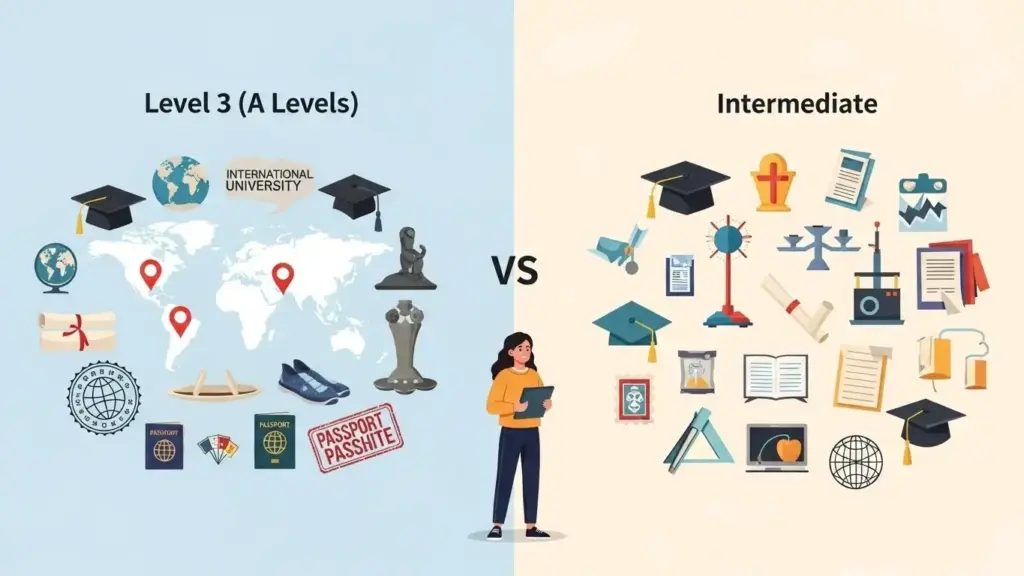
After matriculation, Pakistani students often find themselves at a crossroads, having to choose between Level 3 qualifications (such as Cambridge A Levels or Edexcel) and the Intermediate programs (FA, FSc, ICS, ICom) offered by local boards. While both aim to prepare students for higher studies, Level 3 has emerged as the more attractive choice for those seeking international recognition, academic flexibility, and a modern approach to learning.
Level 3 qualifications focus on depth over breadth, allowing students to choose subjects aligned with their career goals while encouraging critical thinking, problem-solving, and independent research skills. On the other hand, the Intermediate system tends to follow a rigid, rote-learning-based structure that prioritizes memorization over understanding.
Moreover, Level 3’s global acceptance gives students a competitive edge for admission into prestigious universities abroad, and even in Pakistan, many top private universities prefer or give weight to A-Level graduates.
In an increasingly competitive academic and professional world, students and parents are recognizing that Level 3 offers not just an education but a springboard to global opportunities.
Level 3 qualifications have gained significant popularity due to their global recognition, flexible learning, and enhanced academic quality. This article explores why Level 3 can be considered better than Intermediate in Pakistan.
International Recognition in Level 3 VS Intermediate
One of the biggest advantages of Level 3 qualifications, such as A Levels, is their worldwide acceptance. Recognized by universities in the UK, USA, Canada, Australia, and many other countries.
Level 3 Advantages
Level 3 certificates are considered a standard benchmark for academic excellence. They follow globally aligned curricula and are assessed by reputable examination boards like Cambridge and Edexcel, ensuring consistency and credibility across the world. This makes it far easier for Pakistani students to apply directly to international universities without needing additional foundation courses or equivalency programs.
- Level 3 qualifications, such as Cambridge International A Levels, Pearson Edexcel, and IB, are recognised by universities worldwide, including top institutions in the UK, USA, Canada, Australia, and beyond.
- Intermediate, while respected in Pakistan, may require equivalence certificates or additional entry tests for admission to foreign universities.
In contrast, the Pakistani Intermediate qualification often requires extra verification, standardized tests, or bridging courses before being accepted abroad, limiting immediate global opportunities. Level 3 offers a direct gateway to global higher education without extra hurdles.
Intermediate Limitations
While the Intermediate program (FA, FSc, ICS, ICom) is a long-standing part of Pakistan’s education system, it has several limitations that can hinder a student’s academic growth and global competitiveness:
- Rote Learning Focus: The curriculum often emphasises memorisation over understanding, leaving little room for critical thinking or practical application.
- Limited Subject Flexibility: Students are bound to pre-set subject combinations, restricting the chance to tailor studies according to career goals.
- Outdated Curriculum: Many textbooks and teaching methods have not kept pace with modern developments in science, technology, and global education standards.
- Lower Global Recognition: Intermediate qualifications are not directly accepted by most foreign universities without additional tests or foundation programs.
- Exam-Oriented System: The heavy reliance on final board exams means that students’ abilities in research, analysis, and communication are often underdeveloped.
Curriculum Depth and Flexibility
Level 3’s subject flexibility better aligns with modern academic and career needs.
Level 3 Advantages
Level 3 qualifications, such as A Levels, are designed to provide in-depth knowledge in selected subjects while offering students the freedom to choose areas of interest. This approach allows learners to specialise early, aligning their studies with future academic or career paths. Key advantages include:
- Early Specialisation: Students can focus on subjects aligned with future academic or career goals.
- Critical Thinking: Encourages analytical reasoning and research-based learning.
- Diverse Assessment: Evaluation includes coursework, projects, and exams, ensuring a well-rounded assessment of abilities.
- Independent Learning: Students develop skills in self-study, problem-solving, and practical application.
The curriculum encourages critical thinking, analytical reasoning, and research-based learning, moving beyond simple memorisation. Students also benefit from diverse assessment methods, coursework, projects, and exams, ensuring a well-rounded evaluation of their abilities.
Intermediate Limitations
The Intermediate curriculum, although structured for broad coverage, often lacks the depth needed for modern academic and professional demands. Students are confined to fixed subject groupings, reducing their ability to customize their studies according to strengths or aspirations. Its limitations include:
- Fixed Subject Groupings: Students cannot easily customise subjects based on their strengths or career interests.
- Theoretical Focus: Teaching is mostly exam-centred, relying on memorisation.
- Limited Skill Development: Problem-solving, creativity, and analytical thinking are often underdeveloped.
- Minimal Interdisciplinary Learning: The rigid syllabus restricts exposure to integrated or modern educational trends.
The teaching approach is predominantly theoretical and exam-focused, which can limit the development of problem-solving, creativity, and analytical skills. Furthermore, the rigid syllabus leaves little room for interdisciplinary learning or adaptation to global educational trends.
Teaching and Learning Style
The way students are taught and how they engage with their studies can make a significant difference in their overall learning experience. Teaching style shapes how knowledge is delivered, while the learning style determines how effectively students absorb and apply that knowledge.
Level 3 Advantages
Level 3 programs promote a student-centred learning approach where teachers act as facilitators rather than just lecturers. Lessons encourage class discussions, debates, case studies, and research projects, allowing students to actively participate in the learning process. Key benefits include:
- Active Participation: Lessons include class discussions, debates, case studies, and research projects.
- Conceptual Understanding: Focus on understanding and applying knowledge, not just memorisation.
- Independent Learning: Encourages self-study and the development of problem-solving skills.
- Real-World Application: Students explore practical examples, bridging theory and practice.
- Skill Development: Enhances confidence, creativity, and critical thinking, valued by universities and employers.
The focus is on understanding concepts, applying knowledge, and developing independent study habits. Students are also encouraged to explore real-world examples, which helps bridge the gap between theory and practice.
This style nurtures confidence, creativity, and problem-solving skills, qualities highly valued by both universities and employers worldwide.
Intermediate Limitations
Intermediate education in Pakistan often follows a teacher-centred, lecture-based model, where students passively absorb information. The primary goal is to prepare for annual board exams, which means teaching methods focus heavily on textbook content and memorisation. Its limitations include:
- Passive Learning: Students mainly absorb information without active engagement.
- Exam-Focused: Teaching methods prioritise board exam preparation and memorisation.
- Limited Interaction: Few opportunities for class discussions, research work, or projects.
- Skill Gap: Students may excel in reproducing memorised answers but struggle with critical thinking, innovation, or independent analysis.
Opportunities for class interaction, research work, or project-based learning are minimal. As a result, students may excel in reproducing memorised answers but struggle when faced with tasks requiring critical thinking, innovation, or independent analysis.
University Admissions & Scholarships
Level 3 qualifications offer better university admission opportunities and scholarships compared to Intermediate programs, which often require extra tests or certifications for international recognition.
Level 3 Advantages
Level 3 qualifications, like A Levels, are highly regarded by both local and international universities. Many top institutions in the UK, USA, Canada, and Australia recognise A Levels as a standard entry requirement, often giving students direct admission without foundation programs. Key advantages include:
- Global Recognition: Accepted by top universities in the UK, USA, Canada, Australia, and other countries.
- Direct Admission: Often allows students to enrol without needing foundation or bridging programs.
- Scholarship Opportunities: Strong performance can lead to merit-based scholarships, reducing tuition costs.
- Competitive Edge: Emphasis on critical thinking, research, and practical application makes students stand out during admission evaluations.
Additionally, strong performance in Level 3 exams can open doors to merit-based scholarships, which can significantly reduce tuition costs and provide financial support for higher studies. The focus on critical thinking, research, and practical application makes Level 3 students stand out during university admission evaluations.
Intermediate Limitations
Students completing the Intermediate program may face restrictions in university admissions, especially for international institutions. Intermediate graduates may face challenges in university admissions and scholarships:
- Restricted International Access: Many foreign universities require additional tests or equivalency certifications.
- Limited Scholarships: Fewer merit-based opportunities compared to Level 3 students.
- Higher Competition: Students compete in a larger local pool with less global recognition.
- Skill Gap: Curriculum may not fully prepare students for international admission expectations.
Moreover, scholarship opportunities are generally more limited, and students often compete in a larger pool with less distinction, since Intermediate qualifications are locally focused and less aligned with global academic standards.
Career & Employability in Level 3 VS Intermediate
Level 3 programs equip students with skills and knowledge that enhance employability, giving them an edge over Intermediate graduates in both higher education and the job market.
Level 3 Advantages
Level 3 qualifications provide students with skills and knowledge that are highly valued in today’s job market. The curriculum emphasises analytical thinking, problem-solving, communication, and independent learning, which prepares students for both higher education and professional careers. Key advantages include:
- Analytical Thinking & Problem-Solving: Develops critical thinking and practical problem-solving abilities.
- Effective Communication: Enhances written and verbal communication skills.
- Independent Learning: Prepares students for self-directed learning in higher education and professional settings.
- Global Recognition: Credentials are recognised by multinational companies and top organisations.
- International Career Opportunities: Enables graduates to explore career options worldwide immediately after completion.
Many multinational companies and top organisations recognise Level 3 credentials, giving graduates a competitive edge in recruitment. Additionally, the international recognition of A Levels allows students to explore global career opportunities immediately after graduation.
Intermediate Limitations
While Intermediate qualifications offer foundational education, they often focus on theoretical knowledge rather than practical skills. Graduates may find it challenging to meet the skill requirements of modern industries, and their employability can be limited compared to Level 3 graduates. Intermediate qualifications, while foundational, have several limitations regarding career readiness:
- Theoretical Focus: Primarily emphasises theoretical knowledge over practical skills.
- Limited Employability: Graduates may struggle to meet modern industry skill requirements.
- Local Recognition Only: International career opportunities often require additional qualifications or bridging programs.
- Skill Gap: Less emphasis on communication, problem-solving, and independent learning skills compared to Level 3 graduates.
Flexibility & Subject Choice
Level 3 programs offer greater flexibility in choosing subjects, allowing students to align their studies with personal interests and future career goals, unlike the rigid Intermediate streams.
Level 3 Advantages
Level 3 programs, such as A Levels, offer high flexibility in choosing subjects, allowing students to focus on areas aligned with their interests and career aspirations. Unlike rigid Intermediate groupings, Level 3 students can mix and match subjects across sciences, arts, and commerce streams, tailoring their education to their strengths. Key benefits include:
- Subject Customisation: Students can choose subjects aligned with their interests and career goals.
- Cross-Stream Options: Ability to mix and match subjects across sciences, arts, and commerce streams.
- Balanced Workload: Flexibility allows students to manage their study load effectively.
- Skill Enhancement: Opportunity to pursue electives that build additional skills.
- Strategic Preparation: Helps students align their studies with university programs or future professions.
This flexibility also enables students to balance workload, pursue electives that enhance skills, and prepare strategically for university programs or future professions.
Intermediate Limitations
Intermediate education generally follows fixed subject combinations, leaving little room for customisation. Intermediate programs are generally less flexible, which can affect student engagement and skill development:
- Fixed Subject Streams: Students are restricted to streams like FSc (Pre-Med/Pre-Engineering), ICS, or ICom.
- Limited Customisation: Little room to tailor subjects according to interests or career goals.
- Reduced Exploration: Limits opportunities to explore diverse academic fields.
- Skill Development Gap: Harder for students to build a unique skill set aligned with modern academic or professional requirements.
Learning Resources & Support
Level 3 programs provide extensive learning resources and guidance, helping students study effectively and prepare for higher education, unlike Intermediate programs with limited support.
Level 3 Advantages
Level 3 programs provide students with extensive learning resources and support systems that enhance understanding and academic performance. Students have access to comprehensive textbooks, online learning platforms, past papers, and interactive materials from globally recognised boards like Cambridge and Edexcel. Key benefits include:
- Comprehensive Learning Materials: Access to textbooks, online platforms, past papers, and interactive resources from globally recognised boards like Cambridge and Edexcel.
- Tutoring & Mentoring: Dedicated support to help plan study schedules, prepare for exams, and select university pathways.
- Structured Guidance: Enables independent learning while offering guidance when needed.
- Enhanced Academic Performance: Support systems help students excel both in exams and in practical application.
This structured support ensures that students can learn independently while receiving guidance when needed.
Intermediate Limitations
Intermediate programs generally offer fewer resources and support options:
- Limited Learning Materials: Focus mostly on prescribed local textbooks with fewer supplementary or interactive tools.
- Minimal Mentoring: Academic counselling and guidance are less common.
- Independent Learning Challenges: Students may struggle to navigate studies or prepare strategically for higher education.
- Impact on Performance: Lack of resources and guidance can affect both confidence and academic results.
Additionally, mentoring and academic counselling are less common, which can make it harder for students to navigate challenges or prepare strategically for higher education. The lack of advanced resources and structured guidance can affect both academic performance and confidence.
Language & Communication Skills
Level 3 programs focus on developing strong language and communication skills, preparing students for academic and professional success, unlike the exam-focused Intermediate system.
Level 3 Advantages
Level 3 programs place a strong emphasis on English language proficiency and effective communication, both written and verbal. Students are encouraged to write essays, give presentations, participate in debates, and conduct research, which enhances clarity of expression, analytical thinking, and confidence. Key benefits include:
- Written Communication: Students practice essay writing, reports, and research papers.
- Verbal Communication: Opportunities for presentations, debates, and discussions enhance speaking skills.
- Analytical Thinking: Activities promote clarity of expression and critical reasoning.
- Confidence Building: Encourages self-expression and active participation in academic settings.
- Professional Readiness: Graduates are better prepared to communicate effectively in universities and workplaces.
These skills are not only vital for higher education but also for professional success, as employers highly value graduates who can communicate ideas clearly and work collaboratively in diverse environments.
Intermediate Limitations
Intermediate programs generally focus less on language development and communication practice. Intermediate programs offer less focus on language and communication skills:
- Exam-Oriented: Assessments focus on memorisation and theoretical knowledge.
- Limited Practice: Few opportunities for essays, presentations, or debates.
- Reduced Exposure: Minimal collaborative or research-based activities.
- Skill Gap: Students may struggle with public speaking, academic writing, and teamwork, affecting university and career readiness.
Students may have limited exposure to public speaking, academic writing, or collaborative projects, which can impact their ability to excel in universities or competitive workplaces.
Assessment Method
Level 3 programs use diverse and continuous assessment methods that evaluate understanding and skills, unlike Intermediate programs, which rely mainly on final exams.
Level 3 Advantages
Level 3 qualifications, like A Levels, use a diverse and continuous assessment system that evaluates a student’s understanding, skills, and application of knowledge. Assessments include written exams, coursework, practical projects, and research assignments, providing a more holistic evaluation of a student’s capabilities. Key benefits include:
- Multiple Evaluation Methods: Includes written exams, coursework, practical projects, and research assignments.
- Holistic Assessment: Evaluates understanding, skills, and application of knowledge.
- Consistent Effort: Encourages continuous learning rather than last-minute exam preparation.
- Skill Development: Enhances critical thinking, problem-solving, and analytical abilities.
- University & Career Preparedness: Prepares students for higher education and professional life.
This approach encourages consistent effort throughout the course rather than last-minute exam preparation and helps students develop critical thinking, problem-solving, and analytical skills, which are essential for higher education and professional life.
Intermediate Limitations
Intermediate programs primarily rely on final board exams to assess students’ performance, with limited consideration for continuous evaluation or practical application. Intermediate programs rely heavily on final board exams, which present several challenges:
- Exam-Focused: Limited consideration for coursework or practical application.
- Rote Learning: Encourages memorisation rather than conceptual understanding.
- Incomplete Evaluation: May not accurately reflect a student’s abilities or potential.
- Skill Gaps: Students may lack analytical, problem-solving, and practical skills required for universities or competitive careers.
This exam-focused system can promote rote memorisation instead of conceptual understanding and may fail to accurately reflect a student’s true abilities or potential. As a result, students may perform well in exams but lack essential analytical and practical skills needed for university studies or competitive career paths.
Pathway to Higher Education
Level 3 qualifications provide a clear and internationally recognised route to higher education, while Intermediate students may face additional requirements for admission abroad.
Level 3 Advantages
Level 3 qualifications offer a clear and internationally recognised pathway to higher education. Key benefits include:
- Global University Access: Direct applications to top universities in the UK, USA, Canada, Australia, and Europe.
- Curriculum Alignment: Designed to meet university entry requirements with a focus on research, analysis, and independent learning.
- Scholarship Opportunities: Strong performance can secure merit-based scholarships and specialised programs.
- Competitive Advantage: Prepares students better for admissions compared to traditional local qualifications.
The curriculum is designed to align with university entry requirements, emphasising skills like research, analysis, and independent learning, which prepare students for undergraduate studies. Strong performance in Level 3 subjects can also help students secure merit-based scholarships and specialised programs, giving them a competitive advantage in admissions.
Intermediate Limitations
While Intermediate education provides foundational knowledge, it often limits direct access to international universities. Intermediate education has several limitations in accessing higher education:
- Restricted International Access: Additional courses, standardised tests (SAT, IELTS), or equivalency certificates may be required for foreign universities.
- Limited Preference: Some top local private universities prefer or give weight to Level 3 students.
- Increased Competition: Intermediate graduates may face stiffer competition for admission and scholarships.
- Skill Gap: Curriculum may not fully prepare students for modern university demands.
Graduates may need additional courses, standardised tests (like SAT or IELTS), or equivalency certificates to qualify for admission abroad. Even within Pakistan, some top private universities may prefer or give weight to Level 3 students, meaning Intermediate students might face stiffer competition or additional entry requirements.
Skills for the Modern World
Level 3 programs equip students with essential modern skills like critical thinking, problem-solving, and collaboration, preparing them for global academic and career challenges.
Level 3 Advantages
Level 3 programs equip students with 21st-century skills that are essential in today’s academic and professional environments. Key benefits include:
- Critical Thinking: Encourages problem-solving and analytical reasoning.
- Research Skills: Students learn to gather, evaluate, and apply information independently.
- Digital Literacy: Exposure to technology and online resources enhances modern skills.
- Collaboration & Teamwork: Group projects and discussions develop interpersonal abilities.
- Innovation & Adaptability: Prepares students to handle global challenges and rapidly changing industries.
- Career & University Readiness: Graduates are well-prepared for both higher education and professional environments.
The curriculum encourages independent learning and innovation, preparing students to adapt to rapidly changing industries and global challenges. These skills make Level 3 graduates highly competitive for both higher education and the modern workforce, giving them an edge over peers who follow traditional learning paths.
Intermediate Limitations
Intermediate education focuses mostly on theoretical knowledge, which limits skill development:
- Limited Problem-Solving: Few opportunities to develop analytical and practical skills.
- Minimal Research Practice: Less emphasis on independent inquiry or research-based learning.
- Digital Skills Gap: Limited use of technology or interactive resources.
- Reduced Collaboration: Few group projects or teamwork exercises.
- Adaptability Challenges: Students may struggle to meet the demands of modern universities or workplaces.
Students may graduate with a solid academic record but lack exposure to problem-solving, teamwork, and innovative thinking, which are increasingly required in universities and modern careers. This gap can affect both employability and adaptability in a globalised world.
Conclusion
Choosing the right educational path after matriculation is crucial for academic success, career opportunities, and personal growth. Level 3 qualifications, such as A Levels, clearly offer significant advantages over Intermediate programs in Pakistan.
With deeper curriculum content, greater subject flexibility, advanced learning resources, continuous assessment methods, and a focus on modern skills like critical thinking, communication, and problem-solving, Level 3 prepares students for higher education and global career opportunities.
While Intermediate education provides foundational knowledge, its rigid structure, exam-focused approach, and limited international recognition can restrict students’ options and skill development. Overall, Level 3 stands out as a more versatile, globally recognized, and future-ready pathway for students aiming to excel in universities and competitive careers worldwide.
Frequently Asked Questions (FAQs)
What is Level 3 education in Pakistan?
Level 3 education refers to qualifications like A Levels, which are internationally recognised and provide in-depth study in selected subjects.
How is Level 3 different from Intermediate?
Level 3 focuses on subject depth, flexibility, and skill development, while Intermediate is more exam-oriented with fixed subject groupings and theoretical learning.
Are Level 3 qualifications recognised internationally?
Yes, Level 3 qualifications are accepted by top universities worldwide, including the UK, USA, Canada, Australia, and Europe.
Can Intermediate students apply to foreign universities?
Yes, but they may need additional tests, equivalency certificates, or foundation courses to meet international admission requirements.
Which system offers better career opportunities?
Level 3 graduates have an edge due to their analytical, communication, and practical skills, making them more employable both locally and internationally.
Do Level 3 programs provide scholarships?
Yes, strong performance in Level 3 exams can help students secure merit-based scholarships and financial support for higher studies.
Can students choose their subjects in Level 3?
Yes, Level 3 allows students to mix and match subjects across streams according to their interests and career goals, unlike the rigid Intermediate streams.
What kind of learning resources are available in Level 3?
Students have access to textbooks, online platforms, past papers, interactive materials, tutoring, mentoring, and academic counselling.
How do assessment methods differ between Level 3 and Intermediate?
Level 3 uses a combination of exams, coursework, projects, and research assignments for holistic evaluation, while Intermediate relies mainly on final exams.
What skills do Level 3 programs develop for the modern world?
Level 3 enhances critical thinking, problem-solving, research, communication, collaboration, and adaptability, preparing students for global academic and professional challenges.

Ibrar Ahmad provides professional SEO services under the brand SEO with Ibrar, helping education and visa consultancy businesses grow their online visibility and generate qualified leads. I specialize in SEO for visa consultancy companies, schools, institutes, and online education platforms. My work focuses on attracting students and parents who are actively searching for admissions, study abroad options, and educational services.

0 Comments